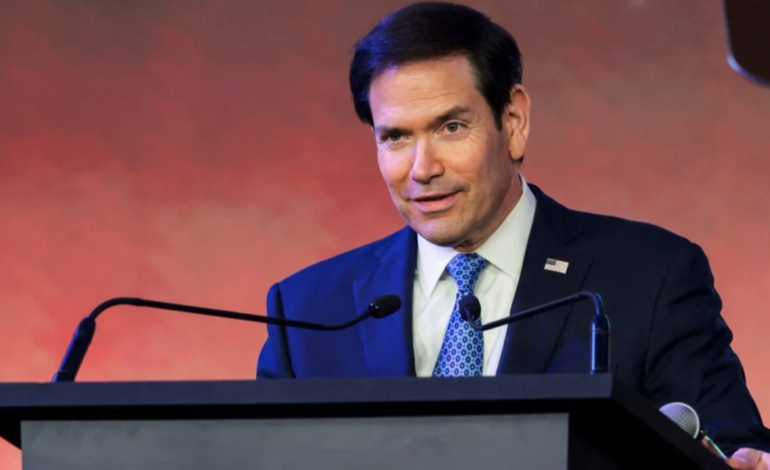
Rubio highlights Pakistan’s concerns over terrorism from Afghanistan amid border clashes

US Secretary of State Marco Rubio has acknowledged Pakistan’s concerns over cross-border terrorism originating from Afghanistan, saying Washington does not want Islamabad to become a target of terrorist attacks.
Speaking at the G20 foreign ministers’ meeting in Atlanta, Rubio said Pakistan had raised concerns about militant attacks allegedly being supported or organized from Afghan territory. He also questioned whether the Afghan Taliban authorities were doing enough to prevent such activities.
“Pakistan is concerned about terrorist attacks that are being sponsored from the territory of Afghanistan. They think that the Taliban has not done enough to constrain those attacks,” Rubio said.
He added that the United States did not want Pakistan to be targeted by terrorism and acknowledged that Islamabad had taken action in response to the security threat.
Rubio’s comments came amid renewed military tensions between Pakistan and Afghanistan, with Pakistani forces carrying out retaliatory strikes against Afghan Taliban border positions and military installations following reported cross-border firing.
Pakistan launches retaliatory strikes against Afghan Taliban positions
According to Pakistan’s state-run broadcaster Radio Pakistan, Afghan Taliban forces opened fire in the Angoor Adda border area of South Waziristan on October 27. Pakistani forces subsequently responded with heavy weapons, targeting border posts, defensive bunkers and military installations.
Pakistan’s state media reported that several Afghan Taliban personnel were killed and others abandoned their positions during the operation. These casualty claims have not been independently verified.
The Afghan Defence Ministry offered a different account of the incident. It accused Pakistani forces of carrying out four drone attacks targeting the Angoor Adda market and a government-related facility in Paktika province on October 28.
Kabul said Afghan forces retaliated by targeting Pakistani military headquarters and nearby positions, claiming that several Pakistani soldiers were killed or wounded. These claims also remain independently unverified.
The competing accounts highlight the continuing tensions along the Pakistan-Afghanistan border, where exchanges of fire have raised concerns about further escalation.
Why Pakistan and Afghanistan are facing tensions
Relations between Islamabad and Kabul have deteriorated over Pakistan’s allegations that armed groups, particularly the Tehreek-e-Taliban Pakistan (TTP), are operating from Afghan territory and organizing attacks inside Pakistan.
Islamabad has repeatedly urged the Afghan Taliban administration to take verifiable action against militant groups and prevent them from using Afghanistan as a base for cross-border attacks.
The Taliban authorities have rejected accusations that they allow Afghan territory to be used for attacks against neighboring countries. They have also argued that Pakistan’s security challenges are an internal matter.
The recent border clashes have added another dimension to the dispute, with both sides accusing each other of initiating military action.
Washington signals willingness to help ease tensions
Rubio’s remarks indicate that Washington is aware of Islamabad’s security concerns and is prepared to consider a constructive diplomatic role if it can contribute to reducing tensions.
The US secretary of state emphasized that Washington opposes terrorism regardless of where it originates or whom it targets. He also acknowledged that the United States does not maintain particularly close relations with the Taliban authorities.
With Pakistan continuing to demand action against militant groups and Kabul rejecting allegations of providing them safe havens, the dispute remains unresolved. Rubio’s comments have brought renewed international attention to the security situation along the Pakistan-Afghanistan border and the potential role of the United States in facilitating dialogue.