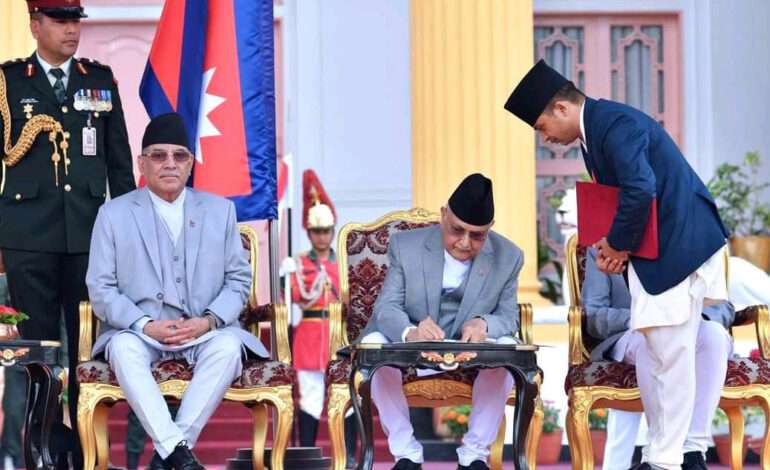
Gen-Z protest aftermath: Nepal President stresses constitutional path to resolve crisis

Amid growing uncertainty following the Gen-Z protest movement and the ouster of Prime Minister K. P. Sharma Oli, Nepal’s President Ram Chandra Poudel has assured that efforts are underway to find a solution within the constitutional framework.
“In the current difficult situation of the country, I am engaged in discussions and every possible effort is being made to find a solution within the constitutional framework so that we can safeguard democracy and maintain peace and order,” President Poudel said in a statement on Thursday.
His remarks come as fears mount over a possible deviation from constitutional provisions, with the Nepal Army currently leading negotiations with Gen-Z leaders. The army has imposed a curfew in Kathmandu Valley until Friday morning to maintain law and order.
While civil society groups and political parties have urged that democracy must be preserved, protests continue, with demonstrators warning against any slide into military rule. President Poudel, as the ceremonial Commander-in-Chief of the army, has indicated that he remains central to negotiations.
Names are being floated for interim leadership, with former Chief Justice Sushila Karki emerging as a frontrunner, backed by Kathmandu Mayor Balen Shah. However, some Gen-Z leaders argue that constitutional provisions bar former justices from assuming government positions, suggesting Kulman Ghising, credited with ending Nepal’s chronic power shortages, as an alternative.
Nepal’s major political parties, including CPN-UML, Maoist Centre, and Nepali Congress, have unanimously called for constitutional solutions. Madhes-based parties also emphasized that federalism, republicanism, and inclusivity must not be reversed.
Civil society networks, including the Brihat Nagarik Andolan, have raised concerns over the army’s direct involvement, warning of long-term institutional risks. Calls continue for dialogue grounded firmly in the Constitution to prevent a prolonged political vacuum.