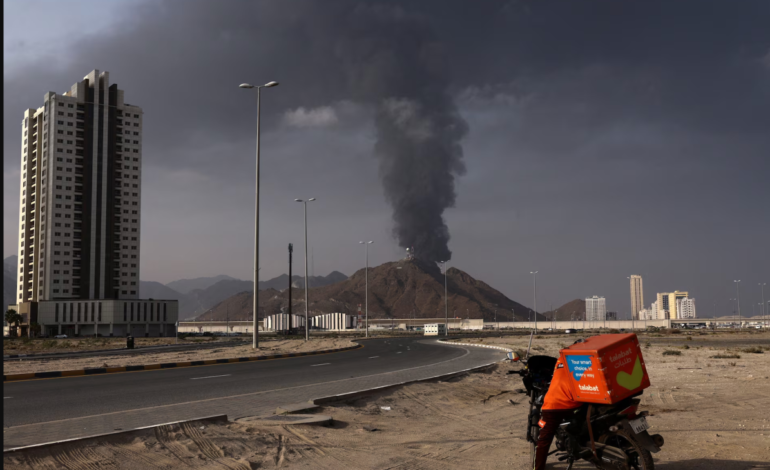
New Iran strikes across Gulf as US attacks escalate, widening regional conflict

By: IndoUS Tribune News Desk
The conflict between the United States and Iran has intensified sharply after both sides exchanged fresh military strikes across the Gulf region, raising fears of a broader regional war and further disruption to global energy supplies.
Iran’s Islamic Revolutionary Guard Corps (IRGC) announced that it launched a new wave of missile and drone attacks targeting locations in Bahrain, Kuwait, Jordan and Oman. The strikes came in retaliation for overnight US military operations against Iranian military infrastructure.
According to the IRGC, the attacks targeted US military installations in Bahrain, radar facilities in Oman, and military sites in Jordan and Kuwait. Iranian officials claimed that several strategic assets were damaged, although independent verification of those claims remains unavailable.
Authorities in Bahrain activated air raid sirens and urged residents to move to safe locations, while Kuwait’s military reported that its air defense systems intercepted hostile aerial targets. Jordan also confirmed intercepting multiple missiles that entered its airspace.
Earlier, the US Central Command (CENTCOM) announced that American forces had carried out precision strikes against dozens of Iranian military targets, including air defense systems, coastal radar installations, missile launch sites, drone facilities and naval assets. Washington said the operation aimed to reduce Iran’s ability to threaten commercial shipping through the strategically vital Strait of Hormuz.
Iranian officials reported that several locations in Khuzestan province were hit during the strikes, with at least one civilian reported killed and several others injured. Iranian media also claimed that air defense forces shot down a US-made drone near Bandar Abbas.
The renewed fighting follows the collapse of a recent memorandum of understanding intended to preserve a ceasefire and facilitate negotiations over Iran’s nuclear program and sanctions relief. Both Washington and Tehran have accused each other of violating the agreement.
The Strait of Hormuz remains at the center of the confrontation. Iran continues to insist that it has authority to regulate commercial traffic through the waterway, while the United States maintains that international shipping must remain free and unrestricted.
Shipping activity through the strait has declined significantly in recent days as commercial operators monitor the deteriorating security situation.
With diplomacy stalled and military exchanges expanding across multiple countries, international concern is growing that the confrontation could evolve into a wider regional conflict with serious consequences for global security, energy markets and international trade.