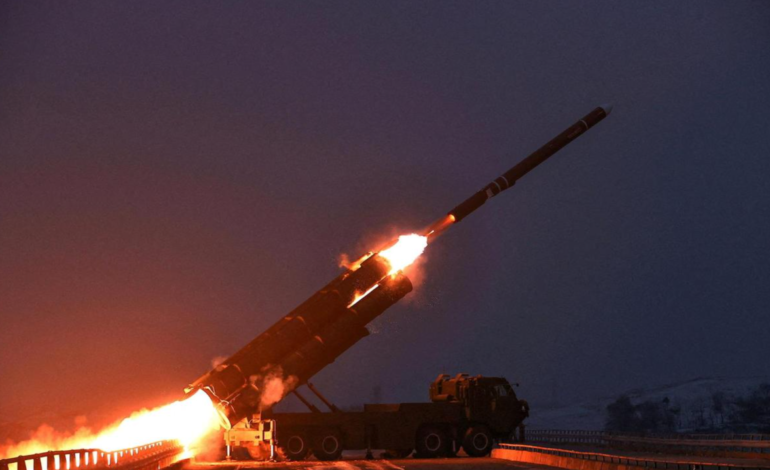
North Korea launches more than 10 ballistic missiles as US-South Korea drills near end

North Korea fired more than 10 short-range ballistic missiles toward waters east of the Korean Peninsula on Thursday, prompting South Korea to convene an emergency security meeting as joint US-South Korea military exercises entered their final stage.
South Korea’s presidential office condemned the launches as a serious violation of United Nations Security Council resolutions and ordered the military to maintain full readiness.
The missiles were launched from the Pyongyang area and travelled approximately 300 kilometres (186 miles) toward the sea, according to South Korea’s Joint Chiefs of Staff. Japan said at least one projectile fell outside its exclusive economic zone, according to Japanese broadcaster NHK.
South Korean Defence Minister Ahn Gyu-back told lawmakers that the weapons were believed to be 600mm multiple rocket launchers. The system, known externally as the KN-25, is considered a significant security concern because of its potential deployment near the inter-Korean border.
North Korea has previously claimed that the 600mm system is capable of carrying tactical nuclear warheads. Ahn also said North Korea is estimated to possess between 80 and 120 nuclear warheads.
The missile launches came shortly after North Korean leader Kim Jong Un’s sister, Kim Yo Jong, criticised the ongoing US-South Korea military exercises. Her remarks followed US President Donald Trump’s decision to substantially reduce US participation in the drills.
The exercises are now scheduled to conclude on Friday, a shortened timeline that followed Trump’s call to revive diplomacy with Kim Jong Un.
Trump said earlier this week that he had received a response from the North Korean leader. However, Kim Yo Jong said she was unaware of any recent communication between the two leaders and maintained that Washington’s “hostile policy” toward Pyongyang remained unchanged.
Yang Moo-jin, a professor at the University of North Korean Studies in Seoul, said the missile launches appeared designed to demonstrate that Kim Yo Jong’s warnings were not merely rhetorical.
He said Pyongyang could be sending several messages at once — opposing the US-South Korea drills, responding to discussions about North Korea’s nuclear capabilities and warning other countries against intervening in its security affairs.
The launches may also have provided an opportunity for North Korea to test or demonstrate improved missile technology, Yang said.
Meanwhile, Chinese Foreign Minister Wang Yi, who visited Seoul this week, urged South Korea not to take sides between Beijing and Washington. He also called for the United States to abandon what Beijing describes as a hostile policy toward North Korea to help reduce tensions on the Korean Peninsula.
The latest missile activity adds another layer of uncertainty to efforts to restart US-North Korea diplomacy while highlighting the continuing security challenges facing South Korea and its allies.