Pakistan revives Sanskrit studies, plans courses on the Gita and Mahabharata

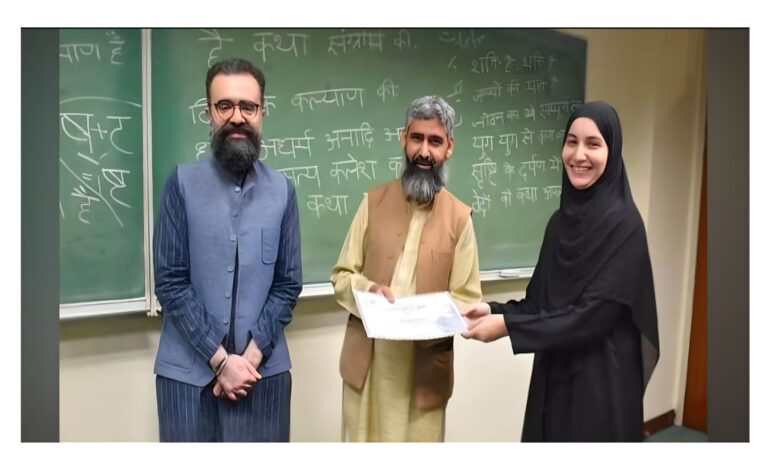
For the first time since the Partition of the subcontinent, Sanskrit has returned to university classrooms in Pakistan. Lahore University of Management Sciences (LUMS) has launched a four-credit Sanskrit course, marking a significant step toward reconnecting with South Asia’s shared classical heritage.
The initiative began as a three-month weekend workshop that attracted strong interest from students and academics. Encouraged by the response, the university formalised it into a full academic course. As part of the curriculum, students are also introduced to cultural adaptations, including the Urdu rendition of the popular Mahabharata television theme, offering a familiar entry point into the classical tradition.
Dr Ali Usman Qasmi, Director of the Gurmani Centre at LUMS, has highlighted the vast but underutilised Sanskrit resources housed in Pakistan. The Punjab University library holds an extensive collection of Sanskrit palm-leaf manuscripts, many of which were catalogued in the 1930s by noted scholar J.C.R. Woolner. Since 1947, however, these materials have largely been accessed only by foreign researchers. According to Dr Qasmi, developing local expertise is essential to reclaiming and studying this intellectual legacy.
Looking ahead, LUMS plans to introduce specialised courses on the Mahabharata and the Bhagavad Gita. Dr Qasmi believes that within the next decade or two, Pakistan could produce its own scholars of these foundational texts, contributing original research from within the region where much of this knowledge tradition emerged.
The revival has been driven in large part by Dr Shahid Rasheed, Associate Professor of Sociology at Forman Christian College. Dr Rasheed, who has studied Arabic, Persian, and Sanskrit, emphasises that classical languages carry universal wisdom rather than religious boundaries. He learned Sanskrit largely through online instruction under international scholars and continues to deepen his studies.
Dr Rasheed argues that Sanskrit belongs to the cultural history of the entire region. He points out that the ancient grammarian Panini lived in this part of South Asia, underscoring the local roots of the language. In his view, renewed engagement with classical traditions across borders could foster greater understanding, allowing languages to serve as bridges rather than divisions in South Asia.