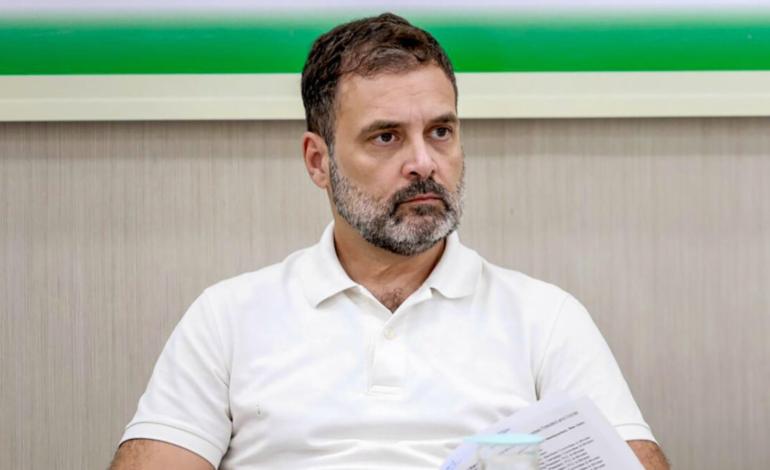
Rahul Gandhi says PM Modi’s vision will fail, accuses Centre of handing manufacturing to China

Leader of Opposition in the Lok Sabha, Rahul Gandhi, on Monday launched a sharp attack on Prime Minister Narendra Modi’s economic and ideological vision, claiming it is fundamentally flawed and will ultimately fail. Speaking in Berlin, Gandhi alleged that India has effectively surrendered its manufacturing base to China, weakening job creation and economic stability.
Addressing students and academics at the Hertie School in Berlin during a lecture titled “Politics Is the Art of Listening,” the Congress leader said India is witnessing a deep ideological struggle over the idea of the nation itself. According to Gandhi, the clash is between two competing visions of India, one that he believes promotes division and social tension.
“A lot of us do not agree with his ideology or the vision of India that he has,” Gandhi said, referring to Prime Minister Modi. “We think that the vision will fail. It creates massive tension in the country and will make Indian people fight with each other. This is a clash between two ideas of India.”
Turning to economic issues, Gandhi claimed that India’s manufacturing sector has weakened significantly under the BJP-led government. He said manufacturing’s share in India’s GDP has declined from around 17 per cent to nearly 12 per cent, which he described as a serious setback for employment generation in a country with a large and growing workforce.
Gandhi accused the Centre of outsourcing production to China, arguing that such dependence undermines India’s long-term economic independence. “To an extent, India has handed over production to the Chinese,” he said, adding that historically, strong manufacturing bases in countries like the United States, Germany, Japan, and South Korea played a crucial role in employment and economic growth.
He warned that economies cannot rely solely on services to create mass employment. “A country like India cannot give jobs to its people only through services. You need manufacturing and production units, and we have handed much of that over to China,” he asserted.
Reflecting on the global debate surrounding democracy and economic productivity, Gandhi said China has demonstrated that large-scale production is possible in a non-democratic system. Democracies, he argued, must now prove that they can compete economically while preserving democratic values.
“In this transition, the question is how democracies produce,” he said. “China has shown that production can happen in a non-democratic environment. We have to prove that production is possible in a democratic environment as well.”
Gandhi emphasised that manufacturing, micro, small and medium enterprises (MSMEs), and agriculture remain the backbone of large-scale employment in India. He called for reforms in industrial policy and the Goods and Services Tax (GST) regime to strengthen domestic production and support small businesses.
Reiterating his criticism of demonetisation, Gandhi said the policy dealt a severe blow to small enterprises and contributed to the decline of manufacturing. He linked the move to long-term economic stress faced by MSMEs, which he described as the country’s primary job creators.
The Congress leader concluded by stressing that rebuilding India’s production capacity is essential not only for economic growth but also for protecting democracy and social cohesion.