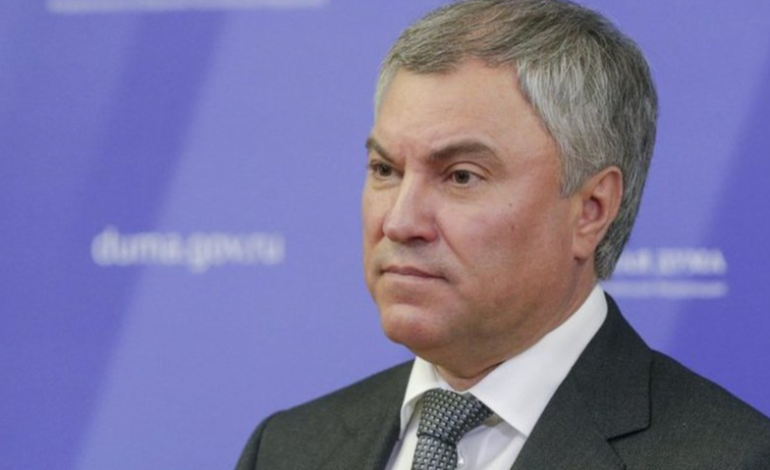
Russian Duma speaker blames EU and Biden allies for Ukraine conflict

Russian State Duma Speaker Vyacheslav Volodin has sharply criticised the European Union and former US President Joe Biden, holding them responsible for the ongoing conflict in Ukraine and accusing Western leaders of prolonging the war to preserve their political power.
Speaking at the final meeting of the Russian parliament’s fall session on Tuesday, Volodin said that the EU, Biden and his political supporters were directly to blame for the violence and loss of civilian lives in Ukraine. According to Russia’s state-run news agency Tass, Volodin described the conflict as a tragedy driven by Western policies rather than Russian actions.
“The EU, Biden and his supporters are to blame for what is happening in Ukraine. It is their fault that many innocent civilians have died. Their hands are stained with the people’s blood,” Volodin said during the parliamentary session.
He argued that Western leaders continue to accuse Russia in order to deflect responsibility and maintain their hold on power. According to Volodin, portraying Russia as an enemy has become a political tool used by certain European governments to rally domestic support and suppress dissent.
“But you and I understand that this is just an attempt to stay in power,” he said, adding that public opinion in Europe would eventually shift. Volodin predicted political changes across European countries once it becomes impossible to sustain what he described as an artificial image of Russia as a threat.
The Russian parliamentary speaker insisted that Moscow has never viewed Europe as an adversary. Instead, he said Russia had played a significant role in supporting Europe’s economic growth by providing affordable energy supplies, which he claimed helped make European industries more competitive.
“Russia has never been an enemy of Europe. It has helped Europe grow by supplying affordable energy, making its economy more competitive,” Volodin said. He accused some European leaders of exploiting fears about Russia to justify policies that serve their own political interests.
Volodin further urged European citizens to hold such leaders accountable, suggesting that meaningful improvements in Europe’s economic and political situation would only occur once these politicians step aside. “The earlier they step down, the sooner Europe will see improvements,” he said.
His remarks follow recent comments by Russian President Vladimir Putin, who has also escalated rhetoric against the European Union. On December 19, during his annual year-end press conference titled “Results of the Year,” Putin described EU efforts to seize frozen Russian assets as outright “robbery.”
Putin argued that any attempt by European nations to confiscate Russian gold and foreign currency reserves would have severe economic consequences for the countries involved. He said proposals to issue reparation loans backed by Russian assets would increase public debt in already financially strained economies.
Highlighting France as an example, Putin pointed out that the country’s public debt stands at around 120 per cent of GDP, compared with Russia’s 17.7 per cent. He warned that taking on new financial obligations would further strain European budgets and undermine fiscal stability.
The Russian president also cautioned that seizing Russian assets would damage trust in the eurozone. He said such actions could alarm other countries that hold reserves in Europe, particularly oil-producing nations, leading them to reconsider where they store their foreign assets.
According to Putin, undermining confidence in the eurozone would have long-term consequences far beyond the immediate geopolitical standoff, potentially weakening Europe’s global financial standing.
Together, the remarks by Volodin and Putin underscore Moscow’s increasingly confrontational stance toward the EU and the United States, as the war in Ukraine continues to fuel deepening geopolitical divisions.