Russian media backs India’s BRICS leadership, praises New Delhi’s response to US Venezuela raid

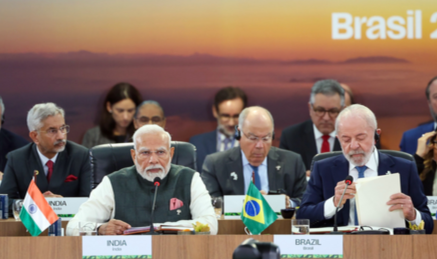
Russian state-affiliated media has expressed confidence in India’s ability to lead the expanded BRICS bloc amid rising geopolitical tensions, praising New Delhi’s measured response to the recent US military operation in Venezuela. An article published on the website of RT, Russia’s international news television network, described India’s approach as balanced and pragmatic at a time when global governance structures face increasing strain.
According to the report, India’s assumption of the BRICS presidency for 2026 places it in a stronger position than China to navigate tensions with an increasingly assertive United States. The article argued that New Delhi’s leadership could help the bloc manage the complexities of shaping a new global trade and economic order while maintaining strategic autonomy amid rivalry between major powers.
“India’s major task is to steer the economic and political mandate of a bloc of such gigantic proportions,” the article noted, adding that New Delhi would need to balance geopolitical challenges involving economy, technology, energy security, and access to critical minerals.
India formally assumed the BRICS presidency at the start of 2026, inheriting leadership of a significantly expanded grouping. BRICS now includes 11 members—Brazil, Russia, India, China, and South Africa, along with Saudi Arabia, Egypt, the United Arab Emirates, Ethiopia, Indonesia, and Iran. The expansion underscores the bloc’s growing weight in the global economy, representing a substantial share of the world’s population and gross domestic product.
The RT article described BRICS as an increasingly important platform for advancing the interests of the Global South and as a counterbalance to Western-dominated institutions such as the International Monetary Fund, World Bank, and United Nations. It noted that BRICS nations aim to promote a multipolar world order and increase developing countries’ influence in international decision-making.
The report linked India’s presidency with the US military operation in Venezuela, during which US forces reportedly captured Venezuelan President Nicolas Maduro. According to RT, the incident highlights perceived failures of global governance and offers BRICS members an opportunity to raise questions about the effectiveness and legitimacy of existing international institutions, particularly the United Nations.
The article praised New Delhi’s cautious diplomatic response to the Venezuela developments, noting that Washington’s actions drew strong condemnation from several BRICS members, including China, Brazil, and Russia. As BRICS chair, India faces what the report described as a “delicate balancing act” in managing divergent viewpoints within the bloc while maintaining working relations with the United States.
RT further observed that India’s BRICS presidency will be closely scrutinised given US President Donald Trump’s openly critical stance toward the grouping. Trump has previously dismissed BRICS as irrelevant, even declaring that the bloc was “dead.” At the same time, he has warned member countries against pursuing alternatives to the US dollar, threatening steep tariffs if BRICS nations attempt to launch a common trade currency.
The report concluded by noting that India’s leadership of BRICS comes at a sensitive moment, as New Delhi simultaneously negotiates a trade agreement with Washington. Those talks have reportedly been complicated by recent US tariff measures, including a 50 per cent duty on Indian goods, partly linked to India’s continued purchases of Russian oil.
According to Russian media, India’s diplomatic posture and economic weight position it as a stabilising force within BRICS, capable of steering the bloc through mounting global uncertainty while defending the interests of emerging economies.