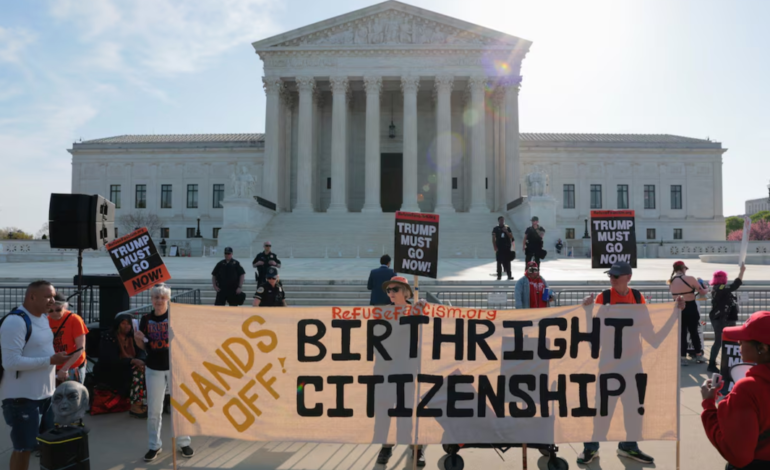
Trump attacks birthright citizenship ahead of Supreme Court hearing

U.S. President Donald Trump has reignited debate over birthright citizenship with a controversial statement ahead of a crucial Supreme Court hearing examining his administration’s efforts to restrict the policy.
In a post on his Truth Social platform, Trump argued that birthright citizenship — a constitutional guarantee under the Fourteenth Amendment — was originally intended for the children of former slaves, not for children born in the United States to foreign nationals.
“Birthright Citizenship is not about rich people from China and the rest of the world who want their children… to become citizens of the United States,” Trump wrote, adding that the provision was meant for the “babies of slaves” following the Civil War.
His remarks come as the U.S. Supreme Court prepares to hear oral arguments in a case challenging an executive order signed by Trump in January 2025. The order seeks to end automatic citizenship for children born in the U.S. to parents who are either in the country illegally or on temporary visas.
Birthright citizenship in the United States is rooted in the Fourteenth Amendment, ratified in 1868 after the Civil War. The amendment established that all persons born or naturalized in the United States, and subject to its jurisdiction, are citizens — a principle that overturned the 1857 Dred Scott decision, which had denied citizenship to people of African descent.
The Trump administration has argued that the phrase “subject to the jurisdiction thereof” does not apply to individuals residing in the country unlawfully or temporarily. Based on this interpretation, officials have maintained that their policy aligns with the original intent of the amendment.
The executive order, which was scheduled to take effect in February 2025, is not retroactive. However, it has faced immediate legal challenges from civil rights groups and several states, who argue that it violates long-standing constitutional protections.
Critics say Trump’s interpretation undermines more than a century of legal precedent and could have far-reaching implications for immigration policy and citizenship rights. Supporters, on the other hand, argue that the current system is being misused and requires reform.
The Supreme Court’s upcoming decision is expected to have significant consequences, not only for immigration law but also for how the Constitution is interpreted in modern America. As the legal battle unfolds, Trump’s remarks have once again placed the issue of citizenship at the center of national debate.