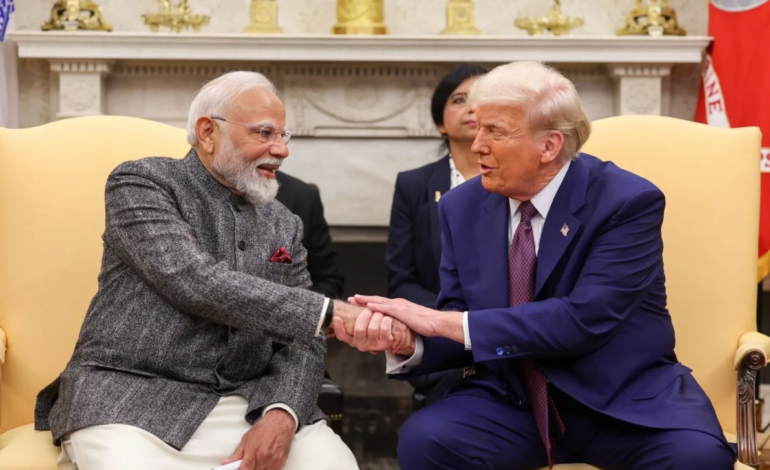
‘US and India share a historic bond’: Trump greets Indians on 77th Republic Day

US President Donald Trump on Monday extended warm greetings to the people of India on the occasion of the country’s 77th Republic Day, underscoring the enduring partnership between the two nations and describing them as the world’s oldest and largest democracies.
In a message shared by the US Embassy in India on social media platform X, President Trump congratulated the Indian government and its citizens, highlighting the shared democratic values that underpin the India–US relationship.
“On behalf of the people of the United States, I extend my heartfelt congratulations to the government and people of India as you celebrate your 77th Republic Day,” Trump said. “The United States and India share a historic bond as the world’s oldest and largest democracies.”
The message reflects the continued emphasis by the Trump administration on strengthening ties with India across political, economic, and strategic domains, amid evolving global and regional challenges.
Earlier in the day, US Secretary of State Marco Rubio also conveyed Republic Day greetings to India, reaffirming Washington’s commitment to deepening cooperation with New Delhi. In a separate statement, Rubio highlighted the breadth of engagement between the two countries, ranging from defence and energy to emerging technologies and regional security.
“On behalf of the people of the United States, I extend my heartfelt congratulations to the people of India on your Republic Day,” Rubio said. “The United States and India share a historic bond. From our close cooperation on defence, energy, critical minerals, and emerging technologies to our multi-layered engagement through the Quad, the US–India relationship delivers real results for our two countries and for the Indo-Pacific region.”
Rubio added that he looked forward to working with Indian counterparts in the year ahead to advance shared objectives and address common challenges.
India celebrates Republic Day every year on January 26 to commemorate the adoption of its Constitution in 1950, marking the country’s transition into a sovereign democratic republic. The occasion is observed with ceremonial events in New Delhi, including the national parade at Kartavya Path, as well as celebrations across states and Union Territories that highlight constitutional values, unity, and democratic traditions.
The Republic Day greetings from US leaders come amid sustained high-level engagement between New Delhi and Washington. In December last year, Prime Minister Narendra Modi held a telephonic conversation with President Trump, during which both leaders reviewed progress in bilateral relations and discussed regional and international developments.
Following the call, Prime Minister Modi described the interaction as warm and productive, noting that both sides reaffirmed their commitment to global peace, stability, and prosperity. “India and the US will continue to work together for global peace, stability and prosperity,” Modi said in a post on X.
During the conversation, the two leaders underlined the importance of maintaining momentum in efforts to enhance bilateral trade and economic cooperation. They reviewed progress under the India–US Comprehensive Global Strategic Partnership and expressed satisfaction with the steady strengthening of collaboration across sectors.
Discussions also focused on expanding cooperation in critical and emerging technologies, energy security, defence, and counterterrorism. Both leaders reiterated their commitment to advancing the India–US COMPACT (Catalysing Opportunities for Military Partnership, Accelerated Commerce and Technology) for the 21st century, which serves as a framework for deepening strategic and economic ties.
The exchange of Republic Day greetings once again highlighted the bipartisan and institutional depth of the India–US relationship, rooted in shared democratic values and increasingly aligned strategic interests in the Indo-Pacific and beyond.