Trump pushes U.S. oil majors to revive Venezuela’s struggling energy sector

U.S. President Donald Trump has urged America’s largest oil companies to take the lead in rebuilding Venezuela’s severely degraded energy industry, calling on them to invest as much as $100 billion to restore production in the oil-rich South American nation.
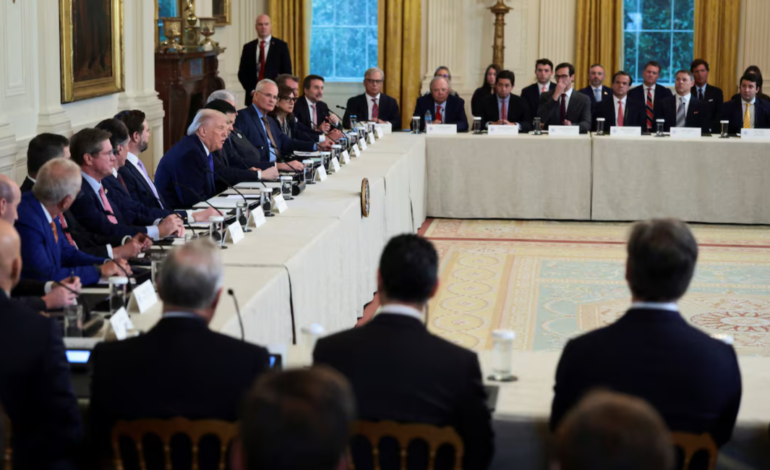
Trump made the appeal during a White House meeting on Friday with senior executives from major energy firms, including Exxon Mobil, Chevron, and ConocoPhillips. The discussions come days after U.S. forces captured Venezuelan leader Nicolás Maduro in a surprise overnight operation in Caracas on January 3, marking a dramatic escalation in Washington’s long-running confrontation with the Maduro government.
Oil has emerged as the centerpiece of Trump’s strategy for Venezuela. Addressing the executives, he described the country’s energy infrastructure as “rotting” and said American companies would be given the opportunity to rebuild it and dramatically expand oil output.
“American companies will have the opportunity to rebuild Venezuela’s rotting energy infrastructure and eventually increase oil production to levels never, ever seen before,” Trump said, adding that his administration would decide which firms are permitted to enter the country.
The president also highlighted a deal with Venezuela’s interim leadership to supply 50 million barrels of crude oil to the United States. Many U.S. refineries are specifically configured to process Venezuela’s heavy crude, and Trump said he expected shipments to continue indefinitely. He argued that increased supplies would help lower domestic energy prices.
“One of the things the United States gets out of this will be even lower energy prices,” he said.
At the same time, U.S. forces continue to enforce a maritime embargo on Venezuelan oil exports. The Trump administration announced its fifth seizure of a Venezuelan oil tanker on Friday, underscoring Washington’s determination to control the country’s oil revenues.
Administration officials have said the United States intends to oversee Venezuela’s oil sales for the foreseeable future to ensure the new authorities act in line with U.S. interests, including reducing corruption and curbing drug trafficking. Critics, including some Democratic lawmakers, have condemned the strategy as coercive and warned it could further destabilize the country.
Despite Trump’s push, major oil companies remain cautious. Industry executives and analysts point to Venezuela’s fragile political environment, high investment costs, and years of underinvestment and mismanagement that have left oil fields, pipelines, and refineries in disrepair.
Exxon Mobil, the largest U.S. oil company, has reportedly concluded that Venezuela is currently “uninvestable.” Chevron, ConocoPhillips, and other majors are said to be wary of committing to large, long-term projects until there is greater clarity on political stability and the regulatory framework. Trading firms such as Vitol and Trafigura, along with Chevron, are competing for U.S. licenses to market Venezuela’s existing crude, but even these efforts have been approached cautiously.
Analysts also warn that Venezuela’s interim leadership faces a delicate balancing act — distancing itself from Maduro while navigating the heavy influence of Washington. Any misstep, they say, could deter foreign investment and prolong uncertainty.
For Trump, however, Venezuela represents both a geopolitical victory and an economic opportunity. By placing U.S. companies at the center of the country’s energy revival, his administration hopes to reshape Venezuela’s oil sector while securing strategic and economic gains for the United States.
Whether U.S. oil giants will ultimately commit the massive capital Trump is seeking remains an open question — one that will depend on how Venezuela’s political transition unfolds in the months ahead.