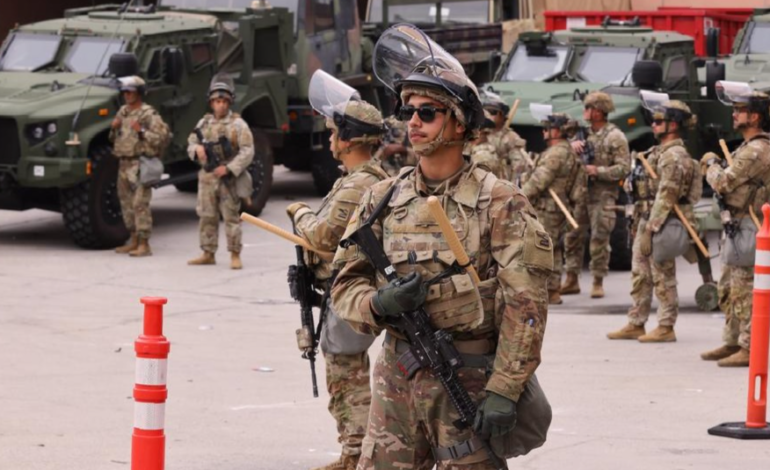
Trump announces withdrawal of National Guard from Chicago, Los Angeles, and Portland after Supreme Court setback

US President Donald Trump has announced that his administration will withdraw National Guard troops from Chicago, Los Angeles, and Portland, just days after the US Supreme Court ruled against the federal government’s authority to deploy the Guard in Illinois.
In a post on his social media platform Truth Social on Wednesday, Trump said the National Guard would be pulled out of the three Democrat-led cities despite what he claimed was a sharp reduction in crime following their deployment.
“We are removing the National Guard from Chicago, Los Angeles, and Portland, despite the fact that crime has been greatly reduced by having these great Patriots in those cities,” Trump wrote. “Portland, Los Angeles, and Chicago were gone if it weren’t for the Federal Government stepping in.”
Trump warned that the federal government could return with stronger measures if crime levels rise again. “We will come back, perhaps in a much different and stronger form, when crime begins to soar again,” he said, sharply criticising Democratic mayors and governors of the affected cities as “greatly incompetent.”
The announcement comes amid an escalating legal and political dispute over the federal use of military forces for domestic law enforcement. Just days earlier, the US Supreme Court rejected the Trump administration’s request to allow National Guard deployment in Chicago to support US Immigration and Customs Enforcement (ICE) operations.
In a 6–3 decision, the court ruled that the federal government had failed to demonstrate the legal authority required to deploy military forces to enforce civilian law in Illinois. “At this preliminary stage, the government has failed to identify a source of authority that would allow the military to execute the laws in Illinois,” the court said in its order.
The controversy dates back to October 4, when Trump federalised approximately 300 members of the Illinois National Guard and ordered them into active service in and around Chicago. A day later, members of the Texas National Guard were also federalised and sent to the city, further intensifying tensions between the federal government and state authorities.
Illinois officials swiftly challenged the move in court, arguing that the deployment violated constitutional limits on the use of military forces in domestic policing. On October 9, the US District Court for the Northern District of Illinois issued a temporary restraining order blocking the federalisation and deployment of the Guard.
That ruling was upheld on October 16 by the US Court of Appeals for the Seventh Circuit. While the appeals court allowed the federal government to federalise National Guard units, it barred their deployment for law enforcement purposes within Illinois.
The Trump administration subsequently appealed to the Supreme Court, which declined to intervene, effectively leaving the lower court rulings intact.
Trump has repeatedly defended the use of the National Guard in Democrat-controlled cities, citing what he describes as surging crime, illegal immigration, and a breakdown of public order. Democrats, however, have accused the administration of politicising public safety and undermining state authority for electoral and ideological reasons.
With the Supreme Court ruling limiting federal options, Trump’s decision to withdraw the National Guard marks a tactical retreat — though his rhetoric suggests the issue is far from settled. As legal battles continue and political tensions deepen, the debate over federal power, public safety, and states’ rights remains a central flashpoint in US governance.