US outlines China deterrence strategy rooted in strength and stability

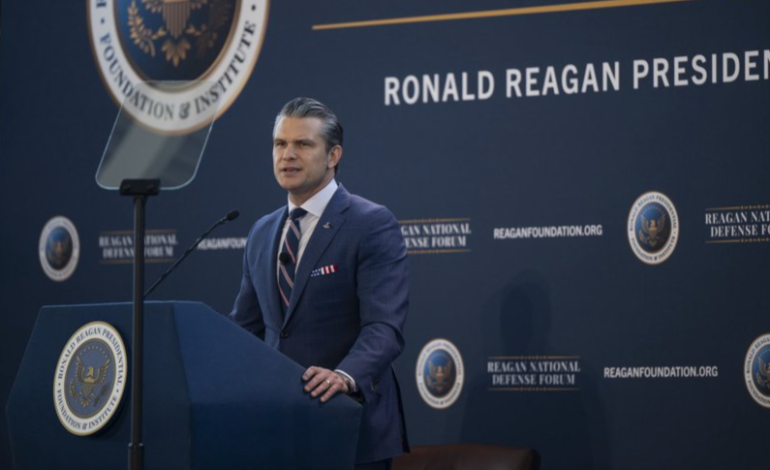
The United States is shaping its China policy around a doctrine of “deterrence through strength,” a strategy aimed at preserving stability in the Indo-Pacific without provoking confrontation, US Secretary of War Pete Hegseth said at a major policy address this week.
Speaking at the Reagan National Defense Forum in California, Hegseth said the Trump administration is pursuing a dual-track approach: strengthening military posture across the Indo-Pacific while maintaining open diplomatic channels with Beijing. He noted that despite significant geopolitical friction, bilateral relations have recently improved, citing what he called a “breakthrough in trade” and upcoming reciprocal state visits in 2026 as signs of a more constructive phase.
Hegseth emphasized that enhanced communication must rest on a foundation of credible deterrence. The approach, he said, is based on “flexible realism, not naivete.” The goal, he added, is to maintain a balance of power that allows nations across the region to prosper in an environment where “trade flows openly and fairly” and national sovereignty is respected.
He stressed that Washington is not seeking confrontation or a containment strategy. “We’re not trying to strangle China’s growth or engineer their humiliation,” he said. “Nor are we trying to alter the status quo over Taiwan.” Instead, he argued, the United States aims to ensure that China cannot coerce its neighbors or undermine regional order.
Central to the administration’s thinking is the belief that deterrence depends on the ability to quickly deploy and sustain forces across the Indo-Pacific, particularly along the first island chain. This posture, Hegseth said, must be strong enough to make any move toward aggression “strategically untenable” for Beijing. Peace, he argued, is best protected when the costs of conflict are overwhelmingly clear.
Hegseth described China’s military modernization as “rapid, formidable, and holistic,” and said the United States would be “silly and frankly disrespectful” not to assess those capabilities with precision. He reiterated that under President Donald Trump, the priority is ensuring the US can “negotiate from a position of strength” and prevent miscalculation between the two nuclear-armed powers. Quoting Theodore Roosevelt, he said, “We will speak softly and carry a big stick.”
He also framed China deterrence as part of a broader realignment of allied responsibilities in the Indo-Pacific. Pointing to South Korea’s recent pledge to dedicate “3.5 GDP” to core defense spending and take primary responsibility for its national security, Hegseth suggested that similar steps by regional partners would reinforce a “shared defensive shield” that complicates unilateral actions by Beijing.
The Indo-Pacific remains the epicenter of global strategic competition, with the United States, China, and regional democracies expanding investments in maritime, cyber, and aerospace capabilities. China’s rapid naval expansion, assertiveness in the South China Sea, and growing influence have pushed Washington, Tokyo, Canberra, and New Delhi to deepen coordination through frameworks such as the Quad.
The administration’s latest strategic outline signals that while Washington is open to cooperation with Beijing, it intends to anchor regional peace on sustained military superiority and strengthened alliances.