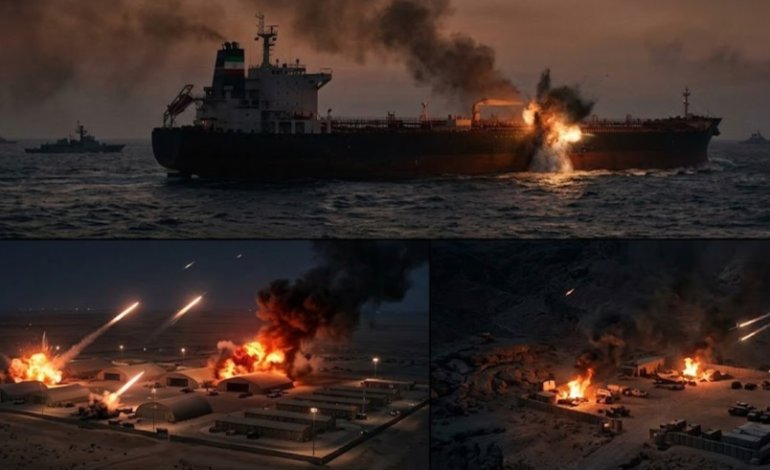
US strikes Iran as Tehran retaliates against Gulf bases; conflict widens amid Strait of Hormuz tensions

The military confrontation between the United States and Iran intensified on Thursday as both sides exchanged fresh strikes, raising fears of a broader regional conflict and further instability around the strategically vital Strait of Hormuz.
According to the U.S. Central Command (CENTCOM), American forces carried out coordinated airstrikes targeting Iranian command centers, air defense systems, missile and drone facilities, and coastal surveillance sites. The operation reportedly extended to areas near Tehran for the first time in the current phase of the conflict, while additional strikes were launched against military installations in Bandar Abbas, Greater Tunb Island, and several other locations.
CENTCOM also announced that U.S. forces disabled an oil tanker attempting to reach Iran’s Kharg Island, saying the action was part of efforts to enforce a renewed naval blockade and prevent activities that could threaten commercial shipping in the Strait of Hormuz.
Iran responded by claiming missile and drone attacks on U.S. military facilities across the Gulf region. Iranian military statements said radar systems, Patriot air defense batteries, fuel depots, and communications infrastructure were targeted at Ali Al Salem Air Base in Kuwait, Sheikh Isa Air Base in Bahrain, and facilities associated with U.S. forces in Jordan.
Regional governments reported defensive measures in response to the attacks. Jordan’s military said it intercepted multiple missiles entering its airspace, while Iraqi authorities reported drone incidents near Erbil, including areas close to U.S. military installations.
Iranian officials warned that continued U.S. military operations could lead to wider consequences for regional energy exports. The Islamic Revolutionary Guard Corps (IRGC) reiterated that if Iran’s oil exports are blocked, energy shipments across the region could also face disruption.
Despite the escalating hostilities, U.S. President Donald Trump said Washington remains open to a negotiated settlement, while Iranian leaders maintained that any future agreement would depend on U.S. actions.
The renewed conflict has heightened concerns over regional security, international shipping, and global energy markets as tensions continue to rise in the Gulf.