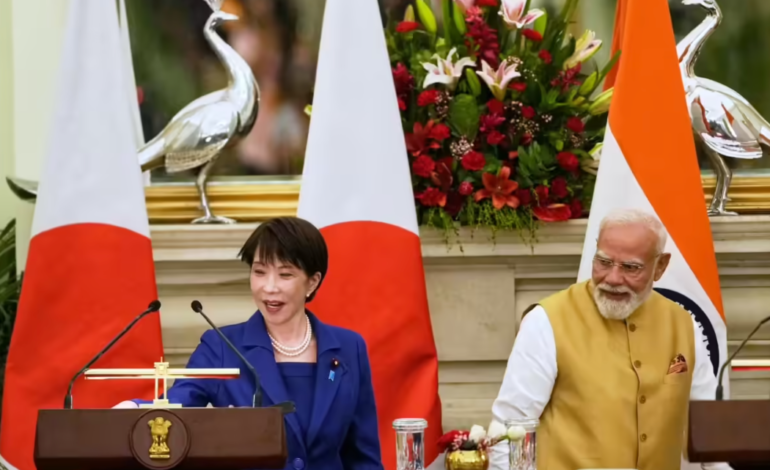
China’s response highlights strategic significance of Modi-Takaichi summit

China’s reaction to the recent meeting between Prime Minister Narendra Modi and Japanese Prime Minister Sanae Takaichi has underscored the growing strategic importance of the India-Japan partnership in the Indo-Pacific. Shortly after the summit, Beijing warned against the formation of “exclusive groupings” targeting third countries, a statement widely interpreted as a response to the expanding cooperation between New Delhi and Tokyo.
The summit resulted in a series of agreements covering defense collaboration, critical minerals, semiconductor supply chains, artificial intelligence, clean energy, and advanced technologies. These sectors have become increasingly significant as countries seek to strengthen economic resilience and reduce dependence on single-source supply chains.
One of the key outcomes was a commitment to deepen defense and security cooperation, reflecting the shared interests of both nations in maintaining peace, stability, and a rules-based order in the Indo-Pacific. The two leaders also reaffirmed their support for freedom of navigation, maritime security, and stronger regional partnerships.
Analysts believe China’s concerns extend beyond any single agreement. Instead, Beijing appears to be watching the broader trend of closer strategic coordination between two of Asia’s largest democracies. As India and Japan continue expanding cooperation in technology, infrastructure, trade, and defense, the partnership is increasingly viewed as an important pillar of regional stability.
Despite China’s criticism, both India and Japan have consistently maintained that their cooperation is not directed against any specific country. Instead, they describe their partnership as one focused on promoting economic growth, innovation, resilient supply chains, and a secure Indo-Pacific.
The summit reflects the steady evolution of India-Japan relations into a comprehensive strategic partnership. As geopolitical competition intensifies across the Indo-Pacific, the growing collaboration between New Delhi and Tokyo is expected to play an increasingly influential role in shaping the region’s economic and security architecture while reinforcing shared democratic values and long-term regional stability.