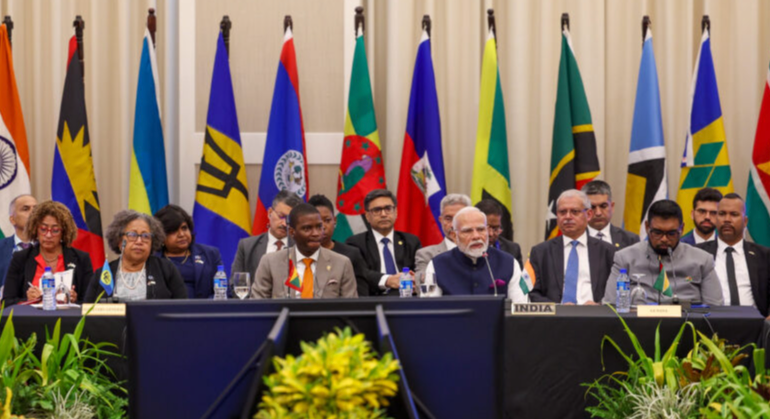
India’s Global South partnerships emerge as core pillar of foreign policy

India’s engagement with the Global South has evolved into a central pillar of its foreign policy, reflecting the country’s growing economic strength, diplomatic reach, and commitment to shaping a more inclusive global order, according to a recent analysis by a former Indian diplomat.
Highlighting shared historical experiences, common developmental challenges, and aspirations for self-reliance, the report underscores how India has transitioned from its early leadership role in the Non-Aligned Movement to becoming a key driver of contemporary South-South cooperation. This transformation has positioned India as both a leader and a partner for developing nations seeking greater representation in global decision-making.
Writing in an opinion piece for a US-based South Asian publication, Ambassador Ashok Sajjanhar noted that India’s outreach to the Global South has gained renewed momentum under Prime Minister Narendra Modi. A landmark initiative in this direction was the launch of the Voice of the Global South Summit shortly after India assumed the G20 presidency. The platform provided developing nations an opportunity to articulate their priorities, concerns, and expectations at a time of significant geopolitical and economic uncertainty.
India subsequently hosted multiple editions of the summit, reinforcing its role as a bridge between advanced economies and the developing world. Beyond convening dialogue, India has actively raised Global South concerns at international forums, advocating for fairer access to development finance, technology, and decision-making structures.
India’s growing influence within the Global South has been further strengthened through its development partnership programmes. The Indian Technical and Economic Cooperation initiative has provided training, capacity-building, and technical assistance to more than 160 countries across Asia, Africa, Latin America, and the Pacific. These efforts reflect India’s approach of demand-driven, non-conditional assistance focused on long-term capacity creation rather than short-term aid.
The report emphasised that one of India’s most consequential achievements during its G20 presidency was facilitating the inclusion of the African Union as a permanent member of the grouping. The move brought 54 African nations into the G20 framework, addressing a long-standing demand from developing countries and reinforcing India’s credibility as a champion of Global South interests.
India’s expanding economic footprint has also enabled deeper engagement with developing nations. Since 2014, the country’s economy has grown rapidly, elevating India’s global standing and increasing its capacity to support international development initiatives. With sustained growth projections, India is expected to play an even more influential role in shaping global economic and governance frameworks.
According to Sajjanhar, India’s approach reflects a broader vision of a multipolar world order in which developing nations have a meaningful voice. By combining diplomacy, economic cooperation, and strategic partnerships, India seeks to promote equitable global governance while advancing shared development goals.
As global power dynamics continue to shift, India’s Global South partnerships are increasingly viewed not merely as diplomatic outreach, but as a defining element of its foreign policy identity—one rooted in mutual respect, shared aspirations, and collective progress in the twenty-first century.