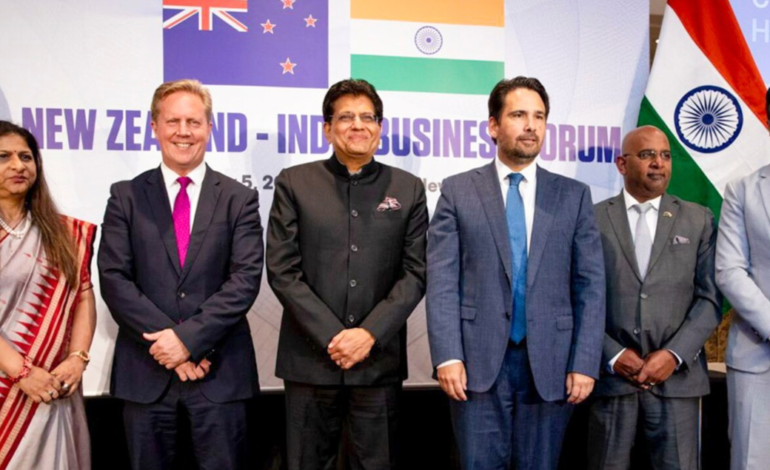
India secures a southern anchor through New Zealand FTA amid global trade uncertainty

India’s recently concluded Free Trade Agreement with New Zealand marks a significant economic and strategic breakthrough, signalling a pragmatic convergence of interests at a time of growing global trade uncertainty. According to a new report, the agreement reflects a forward-looking framework for bilateral cooperation suited to the demands of the mid-21st century.
Published by PRF World, the report describes the FTA as a decisive pivot for New Zealand towards deeper engagement with the world’s most populous nation and one of its fastest-growing major economies. For India, the pact reinforces its “Act East” and Indo-Pacific trade strategies, aimed at building trusted, long-term economic partnerships in a region increasingly shaped by geopolitical competition.
The India–New Zealand FTA was formally concluded last month after negotiations that began in March 2025. The agreement represents a rare instance of convergence between economic ambition and strategic foresight, positioning both democracies to benefit from resilient supply chains, expanded market access, and shared values in a volatile global environment.
Strategically, the report highlights the agreement as a crucial component of the evolving Indo-Pacific maritime and economic architecture. Together with India’s existing trade arrangements with Australia and the United Arab Emirates, the New Zealand deal helps form what the report terms a “Southern Anchor” — a network of democratic trade partnerships designed to promote stability, transparency, and rules-based commerce across the southern Indo-Pacific.
From New Zealand’s perspective, the agreement opens access to India’s vast consumer market and long-term growth story. While some scepticism exists regarding the feasibility of a proposed $20 billion New Zealand investment commitment spread over 15 years, the report clarifies that this figure does not represent government spending. Instead, it reflects private-sector participation through equity investments and business expansion into India’s infrastructure, green energy, manufacturing, and digital sectors, aligned with India’s Vision 2047 development roadmap.
Beyond trade and capital flows, the FTA also addresses labour mobility and skills exchange. The inclusion of special skills categories allows for targeted movement of professionals, positioning the agreement as a form of “talent security” for New Zealand. With its economy projected to face a workforce shortfall of nearly 250,000 workers by the mid-2040s, access to India’s skilled talent pool offers a practical solution to a looming structural challenge.
The report underscores that the real economic value of the agreement extends beyond traditional sectors such as agriculture and manufacturing. Instead, it reflects a modern understanding of economic competitiveness rooted in knowledge, innovation, and human capital — hallmarks of a 21st-century partnership.
Importantly, the agreement is designed with flexibility, allowing for future consultations and expansion as economic priorities evolve. As implementation is expected to begin in late 2026, businesses on both sides are encouraged to view the FTA not as a static document, but as a living framework capable of generating deeper value over time.
In an era marked by supply chain disruptions, protectionist tendencies, and strategic uncertainty, the India–New Zealand FTA signals India’s success in securing a dependable southern economic anchor. Yet, as the report cautions, while an anchor provides stability, its true value depends on the readiness of both partners to fully harness the opportunities it creates.