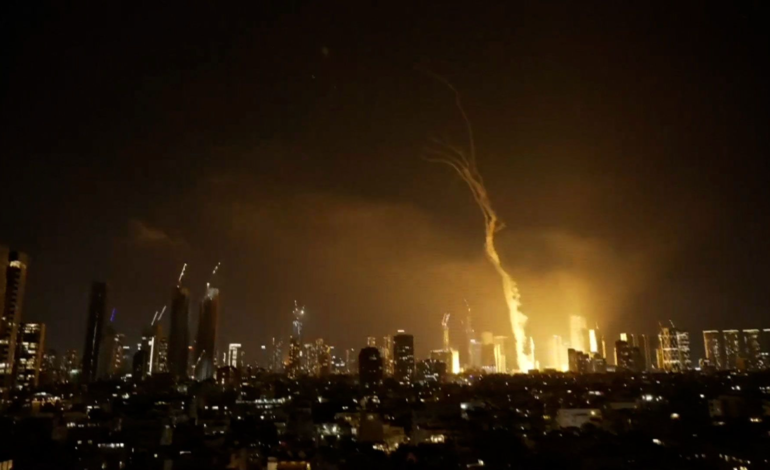
Iran launches missiles toward Jerusalem during Ramadan, Israel condemns attack on sacred sites

Tensions in the Middle East escalated sharply on Monday after Iran reportedly launched missiles toward Jerusalem, prompting strong condemnation from Israel, which described the attack as targeting a city sacred to billions of believers around the world.
Israel’s Foreign Ministry said the missiles were fired toward Jerusalem during the holy month of Ramadan, raising concerns over the safety of some of the world’s most revered religious landmarks. Authorities warned that the strikes endangered sites central to Judaism, Islam, and Christianity.
Sharing a video of the incident on the social media platform X, the Israeli Foreign Ministry stated that the missiles were launched toward areas surrounding some of the city’s most sacred locations.
“The Iranian regime is launching missiles toward Jerusalem, the city sacred to billions of believers, during the month of Ramadan — over the Western Wall, over Al-Aqsa Mosque, over the Church of the Holy Sepulchre,” the ministry said in the post.
Earlier, the Israel Defence Forces (IDF) confirmed that missiles had been fired from Iran toward Israeli territory, marking a significant escalation in the ongoing confrontation between the two regional rivals.
“The IDF has identified that a short time ago missiles were launched from Iran toward the territory of the State of Israel. Defence systems are operating to intercept the threat,” the military said in a statement posted on X.
The IDF added that Israel’s Home Front Command had issued emergency alerts to residents in potentially affected areas. Citizens were instructed to immediately move to protected shelters and remain there until further notice.
“The public is requested to exercise responsibility and act in accordance with the directives — they save lives,” the statement said, emphasizing that people should stay inside protected spaces until authorities issue clear instructions allowing them to leave.
Meanwhile, Iran defended its actions by invoking its right to self-defence. Tehran stated that its response would continue until what it called “aggression” by the United States and Israel ends or until the United Nations Security Council formally identifies the responsible parties.
In a statement released by Iran’s Foreign Ministry, Tehran alleged that joint US-Israeli military operations began on February 28 with the killing of Supreme Leader Ayatollah Ali Khamenei and several senior Iranian officials.
Iran also accused the two countries of carrying out strikes on both military and civilian infrastructure across the country, including schools, hospitals, sports facilities, residential buildings, and public institutions.
Calling the attacks a “flagrant violation of Iran’s territorial integrity and national sovereignty,” the ministry said the actions breached fundamental principles of international law.
Tehran further stated that its response was based on Article 51 of the United Nations Charter, which recognises the inherent right of nations to self-defence against armed attacks.
The statement added that Iran would continue exercising this right until the alleged aggression stops or until the UN Security Council acts under Article 39 of the UN Charter to determine responsibility for the conflict.
The developments mark a dangerous escalation in the already volatile regional situation, raising fears of a broader conflict involving multiple actors across the Middle East.