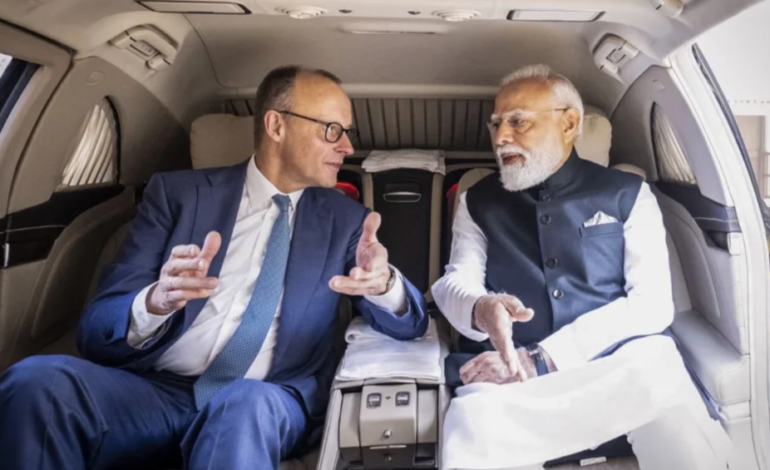
Modi, Merz reaffirm shared commitment to a free and open Indo-Pacific

Prime Minister Narendra Modi and German Chancellor Friedrich Merz on Monday reaffirmed their strong commitment to a free, open and rules-based Indo-Pacific, underlining the importance of respect for international law, including the United Nations Convention on the Law of the Sea (UNCLOS).
During restricted and delegation-level talks held in Ahmedabad, the two leaders reviewed bilateral relations and discussed key regional and global developments. They reiterated shared democratic values, mutual respect and a commitment to a rules-based international order that form the foundation of the India–Germany Strategic Partnership.
A major outcome of the meeting was the announcement of a new bilateral Indo-Pacific consultation mechanism, aimed at strengthening coordination on regional security, maritime cooperation and connectivity. India welcomed Germany’s expanding engagement in the Indo-Pacific region, particularly its participation in initiatives under the Indo-Pacific Oceans Initiative (IPOI), which is co-led by India and Germany. Cooperation under the Capacity Building and Resource Sharing pillar was highlighted as an important contribution to regional stability.
The two leaders also reaffirmed their strong support for the India–Middle East–Europe Economic Corridor (IMEC), describing it as a transformative initiative with the potential to reshape global trade, connectivity and economic prosperity. They expressed optimism about the corridor’s strategic and economic value and looked forward to the first IMEC ministerial meeting to advance the project through concrete steps.
On multilateral reform, Prime Minister Modi and Chancellor Merz reiterated the urgent need for comprehensive reform of the United Nations Security Council. They called for expansion in both permanent and non-permanent categories of membership to better reflect contemporary global realities and stressed the importance of commencing text-based negotiations under the Intergovernmental Negotiations (IGN) framework.
The leaders also discussed major international conflicts and security challenges. They expressed concern over the ongoing war in Ukraine and reiterated their support for efforts to achieve a comprehensive, just and lasting peace in accordance with international law and the principles of the UN Charter. On West Asia, they welcomed the Gaza Peace Plan and described the adoption of UN Security Council Resolution 2803 as a positive step towards ending the conflict, urging all parties to fully implement the resolution.
Climate action and sustainable development featured prominently in the discussions. The leaders underscored the urgency of accelerated global action on climate change and reaffirmed their support for the UNFCCC process and the Paris Agreement. They welcomed progress made under recent climate conferences and stressed the importance of climate finance, technology transfer and just transition mechanisms to support developing countries.
Prime Minister Modi and Chancellor Merz highlighted the role of climate action in driving economic development and poverty reduction, while emphasising the need to scale up climate finance across national and cross-border value chains. They expressed satisfaction with ongoing cooperation under the India–Germany Platform for Investments in Renewable Energy Worldwide, including joint working groups on solar manufacturing, wind energy and battery energy storage solutions.
The two leaders also welcomed progress in cooperation on Green Hydrogen, calling for closer alignment between India’s National Green Hydrogen Mission and Germany’s National Hydrogen Strategy through enhanced technological, regulatory and commercial collaboration.