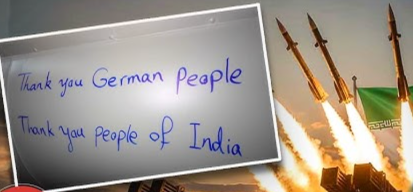
‘Thank you India’ message on Iranian missiles fuels controversy amid West Asia conflict

In a development that has sparked widespread international debate, messages reading “Thank you, people of India” were reportedly seen inscribed on Iranian missiles launched during a recent wave of strikes targeting Israel and United States-linked military installations. The visuals, shared by the Consulate General of Iran in Mumbai on social media, showed personnel marking projectiles with handwritten messages shortly before deployment.
The strikes are part of an ongoing escalation in West Asia following U.S. and Israeli military actions against Iranian-linked targets that began in late February 2026. Since then, the region has witnessed multiple rounds of retaliation, raising fears of a broader and prolonged conflict with global implications.
The appearance of India’s name on the missiles has triggered a mix of confusion, concern, and criticism across diplomatic and public spheres. While the gesture appears symbolic, analysts caution that such messaging can be misinterpreted and may complicate perceptions of India’s carefully maintained neutral stance in the conflict.
New Delhi has consistently emphasized a position of restraint, calling for dialogue and de-escalation while maintaining strategic ties with key players across the region, including the United States, Israel, and Iran. India’s approach reflects a broader effort to balance its energy security interests, diaspora concerns, and geopolitical partnerships without becoming directly involved in regional hostilities.
Experts note that symbolic wartime messaging is not uncommon, often used to project narratives of support or solidarity. However, in a highly sensitive geopolitical environment, such actions can amplify misinformation or create unintended diplomatic ripples.
The incident also highlights the growing role of information warfare and perception management in modern conflicts, where visuals and messaging can travel rapidly across borders, influencing global opinion.
As tensions continue to rise, India’s challenge will be to maintain clarity in its diplomatic messaging and avoid being drawn into narratives that do not align with its official policy. The situation underscores the importance of strategic communication in times of crisis.
For a deeper analysis of India’s position in the ongoing crisis, read our detailed report:
👉 https://indoustribune.com/opinion/indias-calculated-neutrality-amid-the-west-asia-conflict/