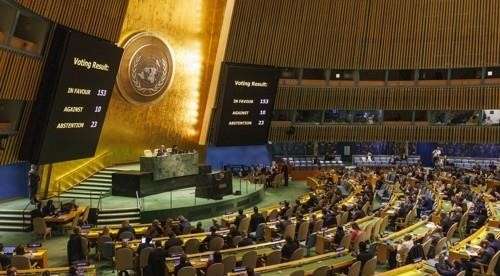
UNGA marks International Day against Nuclear Tests, urges global ban

The UN General Assembly (UNGA) on Wednesday commemorated the International Day against Nuclear Tests, calling for renewed commitment to global disarmament and a world free of nuclear weapons.
Speaking on behalf of UN Secretary-General Antonio Guterres, Izumi Nakamitsu, UN Undersecretary-General and High Representative for Disarmament Affairs, said the event comes at a time of deepening conflict and mistrust. “The prohibition of all nuclear explosive testing is not merely a technical or procedural matter. It is a moral and strategic necessity,” she stressed.
Robert Floyd, Executive Secretary of the Comprehensive Nuclear-Test-Ban Treaty (CTBT) Organization, recalled that nearly 80 years after the first nuclear test and the devastation of Hiroshima and Nagasaki, no nuclear weapon has been detonated in war. However, he noted that during the Cold War, more than 2,000 nuclear explosions took place, averaging “one test every week.”
Since the CTBT opened for signature in 1996, “fewer than a dozen tests” have occurred, Floyd said, calling the treaty “a triumph for science, for multilateralism, and for humanity.”
Vivian Okeke, Director of the International Atomic Energy Agency (IAEA) Liaison Office in New York, highlighted the dual role of nuclear technology. While stressing the urgent need for safety and security, she said nuclear applications are also vital for cancer treatment, food security, environmental protection, and clean energy development.
In December 2009, the UNGA unanimously declared August 29 as the International Day against Nuclear Tests to raise awareness about the devastating consequences of nuclear explosions and the urgent need for their complete cessation.
Global leaders reiterated that preventing nuclear tests is a crucial step toward the long-term vision of a nuclear-weapon-free world.