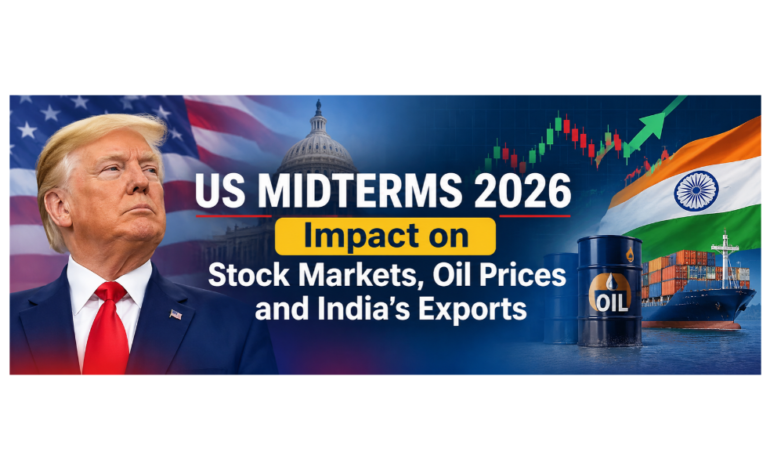
US midterms: How election results could affect stock markets, oil prices and India’s exports

The November 3 US midterm elections could have consequences well beyond American politics, influencing global stock markets, oil prices, currency movements, investment flows and India’s export prospects.
The elections will determine whether President Donald Trump retains Republican control of Congress or faces a legislature increasingly willing to challenge his economic agenda. The outcome could shape economic policy in the world’s largest economy during the final two years of his presidency.
For India, the stakes are significant. The United States is one of its largest trading partners, and changes in American trade policy, consumer demand, interest rates and technology investment can affect Indian businesses and financial markets.
Republican victory could give Trump greater economic flexibility
If Republicans retain control of both the House of Representatives and the Senate, the Trump administration could have greater legislative room to pursue its economic priorities.
These could include tax changes, increased government spending, defence investment and regulatory reforms. Such policies could support business activity and investment, particularly in artificial intelligence, infrastructure and technology.
However, additional tax reductions or spending commitments could also increase the federal deficit and borrowing requirements, potentially putting upward pressure on US Treasury yields.
A divided Congress, particularly if Democrats take control of one or both chambers, could make it harder for Trump to pass new legislation. Congressional investigations and disagreements over government spending could also increase political uncertainty.
However, a Democratic victory would not automatically reverse existing tariffs or other policies implemented through presidential executive authority.
Stock markets could react to the balance of power
Investors are closely watching the elections for clues about future fiscal policy, corporate regulation and government spending.
According to a Reuters analysis published on November 2, US stock markets have benefited from strong corporate earnings and substantial artificial intelligence investment since Trump returned to office in 2025.
A Republican victory in both chambers could support policy continuity, particularly for technology companies and businesses benefiting from deregulation and federal investment.
On the other hand, Democratic control could bring greater congressional scrutiny of major corporations, particularly technology and artificial intelligence companies.
A divided government could also limit the scope for major policy changes, although disagreements over government funding and the debt ceiling could create fresh volatility.
For Indian equity markets, the impact would depend partly on foreign investment flows, the strength of the US dollar, Treasury yields and global risk appetite. Political developments in Washington could influence sentiment, but domestic corporate earnings and valuations would remain important factors.
Oil prices remain critical for India
Energy markets are another major area to watch. India imports a substantial share of its crude oil requirements, making domestic inflation, the rupee and the current account sensitive to international oil prices.
The US midterm results could influence expectations around American energy policy, sanctions, defence spending and relations with major oil-producing countries. However, actual oil prices will depend more directly on global supply and demand, geopolitical developments and the security of shipping routes.
The ongoing US-Iran conflict and uncertainty surrounding the Strait of Hormuz remain particularly important.
On November 2, oil prices fell sharply, with Brent crude declining more than 7% amid hopes of progress in US-Iran negotiations. The movement demonstrated how diplomatic developments can outweigh election-related considerations in determining short-term energy prices.
For India, sustained lower crude prices could reduce the import bill, ease inflationary pressure and provide greater flexibility for monetary policy. Conversely, renewed conflict or disruptions to energy supplies could push prices higher and increase costs for businesses and consumers.
What the elections could mean for India’s exports
India has considerable exposure to the American economy. According to figures cited in an NDTV analysis, Indian merchandise exports to the United States reached approximately $92.3 billion in calendar year 2025, representing 20.75% of India’s total merchandise exports.
This makes American trade policy particularly important for Indian exporters.
Labour-intensive industries, including textiles, engineering goods and manufacturing, could face pressure if tariffs remain high or trade uncertainty delays orders and investment decisions.
Information technology and professional services companies are more directly exposed to American corporate spending, technology investment and immigration policies affecting skilled Indian professionals.
Pharmaceuticals and electronics could experience different effects depending on tariff arrangements, supply-chain requirements and access to the American market.
A Republican-controlled Congress could allow Trump greater flexibility to pursue his legislative economic agenda. However, even a Democratic-controlled Congress would not automatically eliminate existing trade barriers.
For Indian businesses, predictable market access and stable trade arrangements will remain essential.
Dollar, interest rates and foreign investment
The election outcome could also influence the US dollar and international investment flows.
The dollar remains the world’s principal reserve currency, accounting for 56.7% of global foreign-exchange reserves in the second quarter of 2026, according to figures cited in the NDTV analysis.
The Federal Reserve maintained its benchmark interest-rate range at 3.75% to 4% on October 28.
Although Congress does not directly determine monetary policy, fiscal decisions can influence government borrowing, inflation expectations and Treasury yields.
Higher US bond yields could attract international capital towards American assets, potentially putting pressure on emerging-market currencies, including the Indian rupee.
If political uncertainty or concerns about US fiscal deficits increase, investors could reassess their exposure to American assets and diversify internationally.
Indian markets could therefore experience changes in foreign portfolio investment flows, currency movements and borrowing costs.
Technology investment and supply-chain opportunities
The election could also influence global investment in artificial intelligence, semiconductors, electronics and advanced manufacturing.
Continued Republican control could support the administration’s emphasis on deregulation, technology infrastructure and domestic manufacturing. A Democratic-controlled Congress could place greater emphasis on corporate accountability, regulatory oversight and government spending priorities.
For India, both scenarios present opportunities and challenges.
Global companies seeking to diversify supply chains could consider India as an alternative manufacturing and technology destination. However, attracting these investments will depend on infrastructure, skilled workers, reliable electricity, efficient ports and predictable regulations.
Indian technology companies will also need to monitor changes in American corporate spending and immigration rules, particularly those affecting H-1B visas.
What investors and Indian businesses should watch
The midterm results will provide an indication of the political environment in which Trump will pursue his economic agenda.
The key developments to monitor include:
- Trade and tariffs: Whether US tariff policies face greater congressional scrutiny or continue under existing executive authority.
- Stock markets: How investors respond to changes in fiscal policy, corporate regulation and technology spending.
- Crude oil: Whether diplomatic developments involving Iran ease energy supply concerns or renewed tensions push prices higher.
- The dollar and rupee: Whether Treasury yields and international capital flows create additional currency pressure.
- Indian exports: Whether American demand and trade arrangements support or constrain Indian exporters.
- Technology and immigration: Whether policy changes affect Indian IT companies, skilled professionals and investment partnerships.
Ultimately, the November 3 elections will influence the balance of political power in Washington, but their economic consequences will depend on decisions taken afterward.
For India, the priority will be to protect export competitiveness, maintain access to the American market, attract global investment and manage exposure to fluctuations in oil prices and international financial markets.