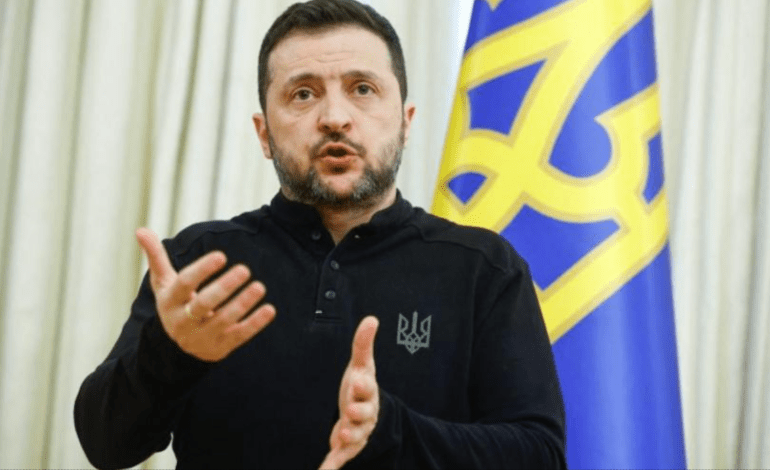
Zelensky ready to sign mineral deal as Europe backs Ukraine

Ukrainian President Volodymyr Zelensky has expressed readiness to sign the previously aborted mineral deal with the United States, following British Prime Minister Keir Starmer’s announcement of a European-led “Coalition of the Willing” to support Ukraine.
“If we agreed to sign the minerals deal, we’re ready to sign it,” Zelensky said on Sunday after a summit of European leaders. “The agreement that’s on the table will be signed if the parties are ready,” he told reporters.
However, uncertainty remains over the U.S. position on the deal, which had been finalized but left unsigned. U.S. Treasury Secretary Scott Bessent stated that the agreement would be “rendered moot if he [Zelensky] wants the fighting to continue.”
Zelensky has emphasized that security from the U.S. remains a priority before any agreements, but Bessent reiterated that a peace deal is essential for the mineral agreement to proceed.
European leaders push for peace plan
Meanwhile, Britain and France are working to advance peace efforts led by U.S. President Donald Trump, despite Zelensky’s reservations about negotiations with Russia. Starmer announced that he and French President Emmanuel Macron would coordinate a peace plan with Zelensky before discussing it with Trump.
“We’ve now agreed that the United Kingdom, along with France and possibly one or two others, will work with Ukraine on a plan to stop the fighting, and then we’ll discuss that plan with the United States,” Starmer told the BBC.
Macron previewed the plan in an interview with Le Figaro, suggesting it could begin with a one-month ceasefire, initially covering air, sea, and energy infrastructure, before expanding to ground operations. He emphasized the need for phased negotiations and a peacekeeping deployment to ensure lasting stability.
Britain and France have offered to send troops to Ukraine in a peacekeeping role, ensuring that hostilities do not resume. Starmer aligned with Trump’s push for a lasting peace, stating, “We agree with Trump on the urgent need for a durable peace. Now we need to deliver together,” while stressing that “Europe must do the heavy lifting.”
Europe steps up support amid U.S. uncertainty
The summit, attended by 18 European and Canadian leaders, underscored Europe’s commitment to taking greater responsibility for regional security amid questions over continued U.S. backing under Trump.
NATO Secretary General Mark Rutte highlighted Europe’s growing role in supporting Ukraine against Russia. Macron urged European nations to increase defense spending to 3–3.5% of their GDP, exceeding NATO’s 2% target, noting that Russia currently allocates 10% of its GDP to military expenditures.
Trump has also called for European allies to contribute more to their defense budgets.
Tensions with Trump over minerals deal
Zelensky’s visit to the U.S. last week ended in a heated Oval Office confrontation with Trump and Vice President JD Vance, who accused him of lacking gratitude toward America and rejecting the proposed peace terms. The dispute played out on live television, leaving the mineral deal unsigned. Trump later claimed that Zelensky was not committed to ending the war.
Under the terms of the mineral agreement, a U.S.-Ukraine investment fund would be established, with 50% of revenue from Ukraine’s state-owned minerals, oil, and gas directed into it. A portion of these funds would be reinvested in Ukraine. Some reports suggested that Trump initially sought a $500 billion pledge from Ukraine’s mineral wealth, though this demand was later dropped.
European leaders rally around Zelensky
Zelensky’s reception in Britain sharply contrasted with the tensions in Washington. He was warmly welcomed by Starmer and later met with King Charles. At the summit, European leaders reaffirmed their strong support for Ukraine, signaling a unified stance against Russian aggression.
As Europe strengthens its commitments to Ukraine, the uncertainty surrounding U.S. involvement adds further complexity to the ongoing geopolitical negotiations. The next steps will depend on whether Zelensky and Trump can find common ground on peace efforts and economic agreements.