Personal finance insights: News & Features

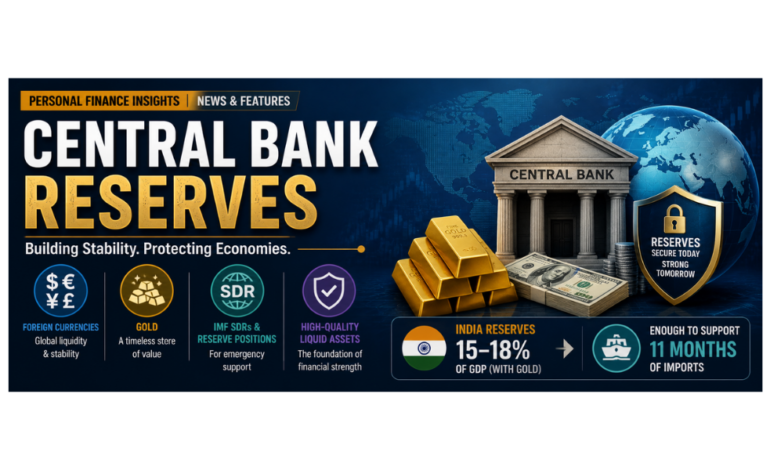
Mini Feature CENTRAL BANK RESERVES
By: Dr K C Gupta, YBB Personal Finance
CONTRARIAN INDICATORS
AAII Bull-Bear Spread -4.4% (below average)
CNN Fear & Greed Index 55 (neutral)
NYSE %Above 50-dMA 50-dMA 55.34% (positive)
SP500 %Above 50-dMA 58.00% (positive)
ICI Fund Allocations (Cumulative), 6/30/26
OEFs & ETFs: Stocks 63.07%, Hybrids 3.86%, Bonds 16.93%, M-Mkt 16.15%
INTEREST RATES
CME FedWatch
Cycle peak 5.25-5.50%
Current 3.50-3.75%
FOMC 9/16/26+ hold
FOMC 10/28/26+ hold
Treasury
T-Bills 3-mo yield 3.88%, 1-yr 4.03%; T-Notes 2-yr 4.24%, 5-yr 4.43%, 10-yr 4.74%; T-Bonds 30-yr 5.27% (normal yield-curve);
TIPS/Real yields 5-yr 2.09%, 10-yr 2.40%, 30-yr 3.00%
FRNs Index 3.750%
Bank Rates www.depositaccounts.com/
Stable-Value (SV) Rates, 8/1/26
TIAA Traditional Annuity (Accumulation) Rates
Restricted RC 5.25%, RA 5.00%
Flexible RCP 4.50%, SRA 4.25%, IRA-101110+ 4.15%
TIAA MYGA 4.60% (3-yr), 4.80% (5-yr), 4.85% (7-yr)
TSP G Fund 4.875% (previous 4.500%)
India Fear & Greed MMI 43.98 (fear)
Weekly ETFs: INDA -0.28%, INDY -0.16%, EPI -0.05%, INDH -0.51% | SPY -1.37%
The data above are as of Sunday preceding the publication date.
ECONOMY
RBI is ending lucrative FCNR deposits deal early on 8/31/26 (vs 9/30/26) having netted $57 billion.
Government of India (GoI) is selling stakes in several public sector companies in FY 2027 (4/1/26 – 3/31/27). The stake sales from almost a dozen companies may raise $8 billion in FY 2027. These companies include Cochin Shipyard, Indian Railways Finance Corp, NHPC (hydropower), Coal India & LIC (life insurance). The recent LIC stake sale reduced GoI stake to 90%. SEBI (securities regulator) rules now require 10% market floats, but GoI had until 05/2027 to achieve that, so this move about 9 months early drew attention. It seems that US-Iran war & foreign fund outflows have put strains on GoI resources & RBI foreign exchange reserves. GoI also has incentive programs for foreign investments & NRI deposits.
INDUSTRIALS
World’s largest HVAC company Japanese Daikin Industries is establishing a R&D center in India to develop HVAC products for the Indian market. These products will include large-scale HVAC systems for commercial buildings, datacenters & industrial facilities that are compatible with local laws. Daikin-India has operations in India since 2000. Daikin-US offers products under brands AAF, Amana*, Daikin, Goodman*, motili, Quietflex, etc. *Doesn’t include kitchen appliances.
INFRASTRUCTURE
US DPR Construction got a big infrastructure contract from the Indian Ministry of Housing & Urban Affairs (MoHUA). Several mega projects will use virtual design & construction (VDC), green-building standards, climate resilience & prefabrication & modular building systems. There will be related technology transfer & local training. These projects will be in New Delhi (central district), Mumbai (coastal residential), Bengaluru (tech sector housing), GIFT City (commercial & residential), Hyderabad (residential), Kolkata (waterfront urban renewal), Chennai (modular transit hubs), Pune (datacenters & housing), Ayodhya (fusion architecture), Guwahati (earthquake resistant modular housing).
SPECIAL TOPIC – CENTRAL BANK RESERVES
Reserve assets as % of GDP vary widely by country. The reserve assets include foreign currencies, gold, IMF SDRs & IMF reserve positions (available in emergencies only). The data reported may be with & without gold. Controversially, some central bank reserves include stocks, corporate bonds & ETFs – BOJ, SNB, several European & EM central banks; even the US Fed held some corporate bond ETFs during Covid pandemic. But most central bank reserve assets are high-quality liquid assets.
These reserve % for developed countries are lower than those for emerging-market (EM) countries. One explanation is that developed economies are more mature, stable, & less susceptible to sudden currency swings. Another is that many developed countries carry gold at historic book values, while most EMs value gold at current prices. But even the non-gold reserves for developed countries are much lower than those for EMs.
Reserve assets for US (without gold) are low because dollar is a global reserve currency & its demand is high. But central banks are diversifying reserve assets into nondollar assets due to concerns about US debt, dollar diplomacy & sanctions – the money in Western banks can suddenly be frozen & become inaccessible.
Due to these reasons, the % reported vary widely by sources. Indian reserves are 15-18% of GDP (with gold), enough to support 11 months of its imports. In 1970s, due to OPEC oil embargo, Bangladesh liberation war & crop failures, Indian reserves were very low. Then, in 1991, due to Gulf War & the collapse of Soviet Union (& that of lot of bilateral trade in rupees or rubles), India literally ran out of reserves & had to secure foreign loans by airlifting planeloads of domestic gold. The current cautions reserve policy of India is intended to avoid repetitions of those situations.
For more information, see https://ybbpersonalfinance.proboards.com/