Opinion: Bhagwat’s message of inclusion meets a divided Indian diaspora in New York

By: Dr. Avi Verma
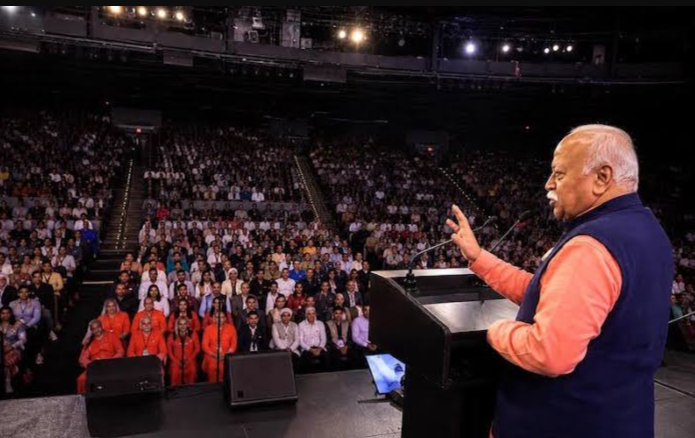
The recent New York appearance of Rashtriya Swayamsevak Sangh chief Mohan Bhagwat became much more than a diaspora gathering. Held during the centenary year of the Rashtriya Swayamsevak Sangh, the “Universal Oneness Celebration” at Madison Square Garden was presented as an initiative promoting cultural dialogue, spiritual unity and the Indian philosophy of Vasudhaiva Kutumbakam, the world is one family. Organized by American Hindus for Engagement and Dialogue, the event brought together thousands of members of the Indian-American community around a message of unity and diversity.
But Bhagwat’s New York appearances quickly became a political and ideological flashpoint, particularly because of the debate surrounding Hindu identity, religious pluralism and the place of Muslims in India.
At the center of that discussion was a significant statement by Bhagwat at the separate “One World One Humanity” faith leaders’ event: “If any Hindu thinks there should be no Muslims in Bharat, he will not remain Hindu.” Bhagwat also said that different religious paths lead toward the same truth and that every human being has dignity.
Regardless of one’s political affiliation, this statement deserves serious attention. It sends a message that Hindu identity cannot be built on the exclusion or hatred of another religious community.
A significant shift toward inclusion
India’s civilizational identity has been shaped by diversity. Hindus, Muslims, Sikhs, Christians, Buddhists, Jains and people of many other traditions have lived together for centuries.
Bhagwat’s statement places the principle of coexistence within his understanding of being Hindu. It rejects the idea that Muslims should somehow be excluded from India’s national life and makes clear that religious identity and respect for other faiths do not have to be contradictory.
Importantly, this is not an entirely new position for Bhagwat. He made similar arguments in 2018, including the assertion that a Hindu Rashtra could not exist without Muslims. His latest remarks therefore represent a reaffirmation of an inclusive interpretation of Hindu identity that he has articulated before.
This is an important message at a time when communal rhetoric can spread rapidly through social media and political platforms.
A message for those who profit from religious hatred
Bhagwat’s emphasis on inclusion can also be seen as a powerful rebuke to the small but vocal group of religious hardliners who seek attention and influence by portraying other faiths as enemies.
Their rhetoric may create applause and headlines, but it does little to strengthen Hindu society and risks damaging India’s longstanding tradition of communal coexistence.
When individuals invoke religion to spread hatred, provoke hostility or create divisions for political, organizational or personal gain, they do a disservice to the very faith they claim to defend.
Bhagwat’s statement therefore carries a particularly pointed message: Hinduism does not become stronger by eliminating space for another religion. It becomes stronger when its followers demonstrate confidence, compassion and the ability to coexist.
For those who have made a habit of attacking other communities in the name of Hinduism, such a position should be a moment for introspection.
From celebration to controversy
The Madison Square Garden program nevertheless attracted strong political opposition. New York City Mayor Zohran Mamdani publicly criticized the RSS and described its ideological outlook as exclusionary. At the same time, Mamdani said he did not know whether the city had jurisdiction to cancel a privately organized event.
A coalition of 61 civil-rights, faith, community and advocacy organizations also opposed the event and pressed for its cancellation. Critics raised concerns about the RSS’s ideology and its record on minority rights and religious polarization in India.
Supporters of Bhagwat and the event, meanwhile, argued that the RSS and Hindu Americans were being portrayed through the most controversial interpretations of their ideology and that the organization’s broader cultural and social work deserved consideration. The organizers presented the gathering as an expression of Hindu American identity, interfaith engagement and the principle of universal oneness.
The result was a familiar pattern in diaspora politics: a cultural event became an ideological battlefield.
Inclusion is not weakness
The controversy also raises a larger question about what religious confidence means in a pluralistic society.
True confidence in one’s faith does not require hostility toward another faith. A Hindu does not become less Hindu because a Muslim lives beside him, just as a Muslim does not become less Muslim because his neighbor is Hindu.
The principle of Vasudhaiva Kutumbakam carries little meaning if it applies only to people who share one’s own religion or ideology.
The Indian-American community, perhaps more than most, understands the practical value of coexistence. Families from different religious and regional backgrounds work together, attend each other’s celebrations, conduct business together and build common institutions in the United States.
A divided diaspora needs a better conversation
The New York controversy has exposed the deep polarization that exists within sections of the Indian-American community. One side sees Bhagwat’s appearance as an expression of cultural pride and a legitimate presentation of Hindu thought on an international stage. The other views it through the lens of concerns about majoritarianism and minority rights. The public opposition to the event demonstrated that these divisions extend well beyond political parties and into questions of identity, religion and representation.
Both cultural pride and legitimate criticism have a place in a democratic society.
What should have no place is the deliberate use of religious hatred to build personal influence.
Community leaders and activists on every side have a responsibility to lower the temperature. Criticism of an organization should not become hatred of an entire religion, and defense of one’s religion should not require demonizing another community.
The larger meaning of Bhagwat’s statement
The significance of Bhagwat’s statement will ultimately depend on whether this message of inclusion is reflected consistently in public discourse and community engagement.
Nevertheless, the words themselves are important. At a time when religious divisions are frequently exploited for political and personal purposes, saying clearly that Muslims have a place in India, and that rejecting their presence is incompatible with his understanding of Hindu identity, is a message worth examining seriously.
The Indian diaspora should welcome any movement away from exclusion and toward dialogue.
The lesson from New York should therefore not be another round of Hindu-versus-Muslim confrontation. It should be a reminder that India’s diversity is not a weakness to be exploited but a strength to be protected.
Those who build their personal agendas by spreading hatred between religions should take note: communal division may provide temporary attention, but it ultimately damages the society and the faith they claim to represent.
The better path is inclusion, mutual respect and dialogue.
Vasudhaiva Kutumbakam, the world is one family.
That message is larger than any organization, politician or controversy, and it deserves to be heard.