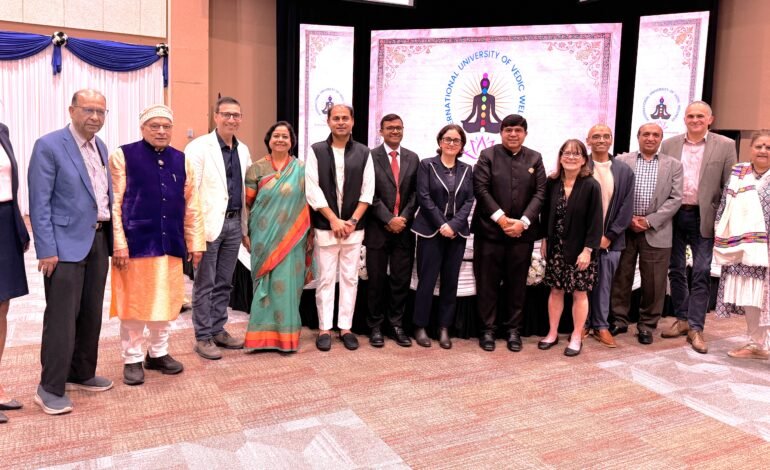
Chicago-area gathering examines global relevance of India’s traditional knowledge systems

By: Dr. Avi Verma
Nearly 250 people attended a seminar titled “Mission Vishwaguru | India’s Ancient Wisdom for Modern Times” on October 30 at the International University of Vedic Wellness (IUVW) in Streamwood, Illinois. The event brought together community representatives, civic leaders, diplomats, scholars and members of cultural and faith-based organizations to discuss the relevance of India’s traditional knowledge systems in contemporary society.
The discussions focused on three major areas of Indian heritage—Yoga, Ayurveda and Vedanta—and their perspectives on physical and mental well-being, philosophy, personal responsibility and peaceful coexistence.
The concept of Vishwaguru, or India’s aspiration to share its knowledge and philosophical traditions with the world, was a central theme. Speakers discussed how these traditions could contribute to modern life through education, wellness practices, self-reflection and community engagement.
Dr. Santosh Kumar, founder of IUVW and host of the seminar, welcomed the participants and spoke about the importance of preserving and sharing India’s philosophical heritage. She highlighted Vedantic teachings, particularly self-inquiry and the recognition of human interconnectedness, as ideas that can encourage compassion and peaceful coexistence.
Rakesh Malhotra, president of the Global Indian Diaspora Foundation (GIDF), said the relevance of India’s traditional values depends on how they are reflected in everyday actions. He cited community service, interfaith understanding, mentoring and volunteering as practical ways for members of the Indian diaspora to put the principle of seva, or selfless service, into practice.
Malhotra also discussed the diaspora’s role in strengthening cultural understanding and people-to-people connections between India and the United States.
Among the guests were Delphine Gamburg, Deputy Consul General of Israel; Sanjeev Pal, Consul at the Consulate General of India in Chicago; Paula McCombie, Mayor of South Barrington; and Billi D. Roth, Village President of Streamwood.
The seminar also featured presentations by Acharya Prayagraj Phule, a Vedantic philosopher; Purvi Pandya, Yoga faculty member at IUVW; and Dr. Pushpa Biradar, Ayurveda faculty member at the university. Their presentations examined the philosophical foundations and practical applications of these traditions, including their potential relevance to modern lifestyles and personal well-being.
Other attendees included Dr. Hitesh Patel of BAPS; Amar Upadhyay; Dipen (Joy) Shah of the Federation of Indian Associations; Acharya Rohit Joshi of ICNT; Arun Mani; Shilpa Nakapati of Heartfulness Meditation; and Dr. Monali Desai, board member of Metropolitan Asian Family Services.
GIDF was represented by Malhotra, General Secretary Abhinav Raina and Chetan Notaria. Media representative Vandana Jhingan also attended. Aditi Chopra served as the master of ceremonies.
The gathering provided an opportunity for representatives of diplomatic missions, local government, educational institutions and community organizations to exchange views on India’s intellectual and cultural traditions.
A recurring theme throughout the program was that the global relevance of Yoga, Ayurveda and Vedanta lies not only in their historical origins but also in how their principles are understood and applied today. Speakers emphasized that cultural knowledge can contribute to dialogue across communities when shared through education, mutual respect and practical engagement.
The seminar concluded with an emphasis on continued dialogue and collaboration among institutions and community organizations interested in promoting India’s traditional knowledge and cultural heritage.