Krishnamoorthi raises alarm over rise in anti-South Asian hate; also seeks review of microplastics in drinking water

By: Dr Avi Verma
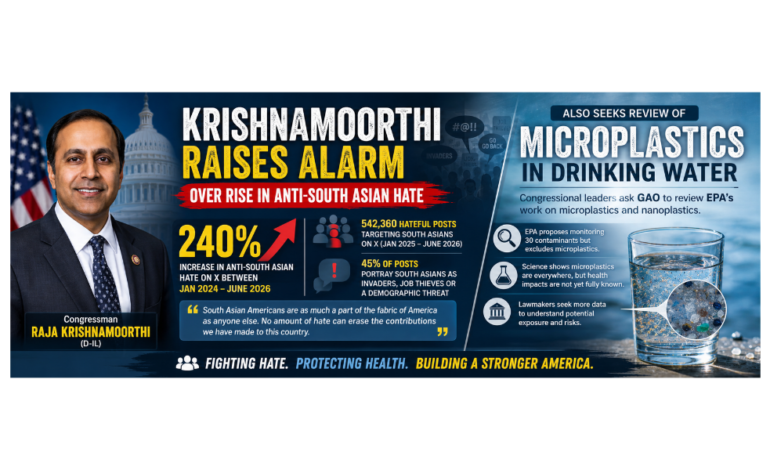
Congressman Raja Krishnamoorthi (D-IL) has called attention to two issues with potential implications for the South Asian and broader American communities: a new report documenting a sharp increase in anti-South Asian hate on social media and a congressional effort seeking greater federal scrutiny of microplastics in drinking water.
The two developments were announced by Krishnamoorthi’s office as Congress returned its attention to issues involving public safety, civil rights and public health.
240% increase in anti-South Asian hate on X
Krishnamoorthi was responding to a new report by the Center for the Study of Organized Hate (CSOH) titled The Rising Tide of Anti-South Asian Hate in the United States. The report examined online content targeting South Asians across X, 4chan, 8chan and Gab during 2025 and the first half of 2026.
According to the report, researchers identified approximately 542,360 hateful posts targeting South Asians on X between January 2025 and June 2026. The report says the monthly volume of anti-South Asian hate on X increased 240% between January 2024 and June 2026, rising from 12,904 posts to 43,843.
The report found that approximately 45% of the identified posts portrayed South Asians as invaders, job thieves or a demographic threat. CSOH attributed the online hostility to several factors, including immigration politics, economic resentment, political rhetoric and the amplification of hateful content through social-media platforms.
For the Indian-American and wider South Asian community, the report’s findings touch on issues that have become increasingly visible in national discussions about immigration, employment, H-1B visas and the growing presence of South Asians in American public life.
At the same time, the figures should be understood in context. The CSOH study measures identified online posts and does not represent a count of physical attacks, hate crimes or individual victims. Its conclusions are based on the organization’s methodology, including keyword-based data collection, automated classification and qualitative review.
Krishnamoorthi calls for response from both barties
Responding to the report, Krishnamoorthi said the increase in online anti-South Asian hostility should concern Americans across the political spectrum.
“The 240 percent surge in monthly anti-South Asian hate on X did not come out of nowhere,” Krishnamoorthi said in a statement released by his office. He called on Americans and political leaders from both parties to speak out against racism and xenophobia.
Krishnamoorthi also cited what he described as examples of politicians and government rhetoric targeting South Asians.
“South Asian Americans are as much a part of the fabric of America as anyone else,” he said, adding that “no amount of hate can erase the contributions we have made to this country.”
The Congressman’s references to particular political incidents and rhetoric are his characterization of those events; they are separate from the statistical findings of the CSOH report.
The report itself says anti-South Asian content includes attacks based on ethnicity, nationality, religion, language, appearance and immigration status. It also documents the use of racist memes and AI-generated imagery to reinforce stereotypes about South Asians.
Microplastics: Krishnamoorthi seeks federal review
In a separate initiative, Krishnamoorthi joined Congresswoman Janelle Bynum (D-OR) and Congresswoman Bonnie Watson Coleman (D-NJ) in leading colleagues in asking the Government Accountability Office (GAO) to review the Environmental Protection Agency’s work on microplastics and nanoplastics.
The lawmakers’ September 30 letter follows the EPA’s proposal for its Sixth Unregulated Contaminant Monitoring Rule (UCMR 6). The proposed rule would require monitoring for 30 contaminants but does not include microplastics. The lawmakers are asking GAO to examine what EPA has accomplished, what work remains and what factors may be limiting further progress.
The lawmakers note that EPA said in 2024 it was in the early stages of developing a method for analyzing microplastics. EPA later cited the absence of a validated analytical method when explaining why microplastics were not included in UCMR 6.
The congressional letter argues that Americans need more information about potential exposure and the possible health implications of microplastics.
What science says—and does not yet say
The issue has attracted increasing scientific attention. A July 2026 GAO report said microplastics are found in air, land and water and can enter the human body. It also noted that some studies have associated exposure with health problems, but emphasized that scientists have not yet determined the extent to which microplastics cause those problems.
GAO also identified significant scientific challenges, including the lack of standardized measurement methods and uncertainties in interpreting research findings.
The distinction is important: the presence of microplastics in the environment and human tissues has been documented, while the full health consequences of exposure remain an active area of scientific research.
Issues resonating with the Indian-American community
For Chicago’s large Indian-American and South Asian population, the two developments highlight very different but consequential national conversations.
The anti-South Asian hate report focuses on how immigration debates, economic grievances and political rhetoric can translate into online hostility directed at an entire ethnic community. The microplastics initiative, meanwhile, concerns the scientific monitoring of a widespread environmental contaminant and what information federal agencies should collect to assess potential risks.
Krishnamoorthi’s involvement in both matters places the Illinois congressman at the center of discussions involving civil rights, immigration-related rhetoric, environmental monitoring and public health.
As the debate continues, the available evidence also underscores the importance of distinguishing documented data from political interpretation—whether discussing online hate or emerging scientific questions about microplastics.
For South Asian Americans, the CSOH report provides a measure of the online environment documented by its researchers, while the congressional initiative on microplastics seeks additional federal information that lawmakers say is necessary to better understand potential exposure and risks.