Protect your vision, protect your life – Part 4

Children’s Eye Health: Protecting Vision During the Most Important Years
By: Dr. Avi Verma
Introduction: Healthy Eyes, Healthy Future
A child’s vision is one of the most important foundations for healthy growth and development. Nearly eighty percent of a child’s learning occurs through the eyes, making good vision essential for academic success, social interaction, physical coordination, and overall confidence. Yet many childhood eye disorders develop silently. Unlike adults, children often do not realize that their vision is abnormal because they assume everyone sees the world the same way they do.
Parents frequently attribute poor school performance, lack of concentration, or behavioral changes to learning difficulties when, in reality, an undiagnosed vision problem may be the underlying cause. The encouraging news is that most childhood eye conditions are highly treatable when diagnosed early. Timely intervention can prevent permanent vision loss and allow children to develop normal visual skills that will benefit them throughout life.
In this fourth installment of our Protect Your Vision, Protect Your Life series, we examine the most common eye disorders affecting children, discuss warning signs parents should recognize, and explain why early eye examinations are among the most important investments in a child’s future.
Amblyopia (Lazy Eye): A Race Against Time
Amblyopia, commonly known as Lazy Eye, is one of the leading causes of preventable vision impairment in children. The condition develops when one eye fails to communicate effectively with the brain. As the brain increasingly relies on the stronger eye, vision in the weaker eye gradually deteriorates.
Lazy eye may result from unequal refractive errors, crossed eyes (strabismus), congenital cataracts, or drooping eyelids that interfere with normal visual development. Since children rarely complain about poor vision in one eye, parents should watch for subtle signs such as frequent head tilting, poor depth perception, difficulty catching a ball, or consistently closing one eye while reading or watching television.
The first few years of life represent a critical period for visual development. Treatment during this period is remarkably successful and may include prescription eyeglasses, eye patching, medicated eye drops, or surgery when necessary. Delayed treatment, however, may result in permanent vision loss that cannot be corrected later in life.
Strabismus (Crossed Eyes): More Than a Cosmetic Concern
Strabismus is a condition in which the eyes fail to align properly and point in different directions. One eye may turn inward, outward, upward, or downward while the other focuses normally.
Many parents mistakenly believe children will “grow out of” crossed eyes. Unfortunately, untreated strabismus can interfere with normal brain development, impair depth perception, and eventually lead to amblyopia.
The condition may arise from abnormalities in the eye muscles, nerve control, neurological disorders, or significant uncorrected refractive errors. Modern ophthalmology offers several effective treatment options, including corrective glasses, vision therapy, prism lenses, eye muscle exercises, and surgical correction when indicated.
Early diagnosis significantly improves the likelihood of restoring normal eye alignment and binocular vision.
Refractive Errors: The Most Common Cause of Blurred Vision
Refractive errors are among the most common eye problems encountered during childhood. They occur when the eye cannot properly focus light onto the retina, resulting in blurred vision.
The three principal refractive errors include myopia (nearsightedness), hyperopia (farsightedness), and astigmatism, each affecting vision differently.
Children with refractive errors may frequently squint, rub their eyes, complain of headaches after reading, sit unusually close to televisions or digital screens, or lose interest in classroom activities requiring clear distance vision.
Fortunately, these conditions can usually be corrected easily with properly prescribed eyeglasses. In selected older children, contact lenses may also be appropriate under professional supervision.
The Rising Epidemic of Childhood Myopia
One of the fastest-growing public health concerns worldwide is the dramatic increase in childhood myopia. Eye specialists have observed a steady rise in nearsightedness over the past two decades, particularly among children who spend long hours indoors using computers, tablets, smartphones, and other digital devices.
High myopia is far more than simply requiring stronger glasses. As the eyeball becomes progressively elongated, the lifetime risk of retinal detachment, glaucoma, cataracts, and myopic retinal degeneration increases substantially.
Fortunately, modern medicine offers several strategies to slow the progression of myopia. Specialized contact lenses, orthokeratology, and low-dose atropine eye drops have shown encouraging results in carefully selected patients.
Equally important are simple lifestyle modifications. Research consistently demonstrates that children who spend more time outdoors have a lower risk of developing progressive myopia. Parents should encourage outdoor play whenever possible and limit prolonged screen exposure during leisure hours.
Digital Screens and Children’s Eyes
Today’s children belong to the first generation raised almost entirely in the digital age. Smartphones, tablets, computers, gaming consoles, and virtual learning have become an integral part of childhood.
Although digital screens do not permanently damage the eyes, prolonged use frequently causes Digital Eye Strain, leading to eye fatigue, dryness, blurred vision, headaches, neck pain, and reduced concentration.
Parents can greatly reduce these symptoms by encouraging healthy screen habits. The widely recommended 20-20-20 Rule remains one of the simplest preventive measures: every twenty minutes, children should look at an object at least twenty feet away for twenty seconds. Maintaining proper viewing distance, ensuring adequate lighting, and scheduling regular breaks can also reduce visual fatigue.
Outdoor activities continue to provide one of the most effective natural protections for developing eyes.
The Importance of Early Eye Examinations
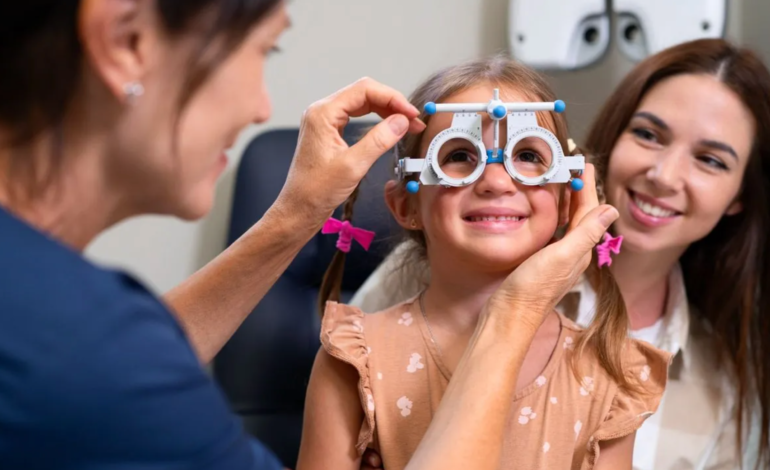
Many serious childhood eye disorders produce few or no obvious symptoms during their early stages. Consequently, routine comprehensive eye examinations remain the most effective way to detect vision problems before they interfere with learning or become permanent.
Eye evaluations should begin during infancy, especially for children born prematurely or those with a family history of eye disease. Additional examinations during the preschool years and before entering school allow ophthalmologists to identify conditions while treatment remains highly effective.
Children diagnosed with refractive errors, strabismus, amblyopia, diabetes, or other medical conditions affecting vision may require more frequent examinations as advised by their eye care professional.
Warning Signs Parents Should Never Ignore
Parents should seek prompt ophthalmic evaluation whenever a child demonstrates persistent eye rubbing, excessive tearing, crossed eyes, unusual sensitivity to light, drooping eyelids, frequent headaches, blurred or double vision, difficulty reading, sitting unusually close to books or television screens, or a white reflection appearing in photographs.
These symptoms may indicate underlying eye disease requiring immediate medical attention. Early diagnosis often makes the difference between complete visual recovery and lifelong visual impairment.
Conclusion: Protecting Vision During Childhood Protects a Lifetime
Childhood offers a unique window of opportunity during which vision develops rapidly and many eye disorders can be completely corrected. Delayed diagnosis, however, may result in permanent visual impairment that affects education, career opportunities, independence, and quality of life.
Parents, teachers, pediatricians, and ophthalmologists all share responsibility for protecting children’s eyesight. Regular comprehensive eye examinations, healthy visual habits, outdoor activities, balanced nutrition, and prompt treatment of eye disorders remain the cornerstones of lifelong eye health.
Protecting a child’s vision is not simply about helping them see better today—it is about safeguarding their ability to learn, explore, achieve, and enjoy life for decades to come.
Coming Next: Part 5 – The Final Article
In the concluding article of this Eye Care Series, we will examine several important topics that affect people of every age, including:
- Eye Injuries and Emergency Care
- LASIK and Vision Correction Surgery
- Eye Pressure and Optic Nerve Damage
- Nutrition for Healthy Eyes
- Contact Lens Safety
- Preventing Blindness
- Importance of Routine Comprehensive Eye Examinations
The final article will bring together practical guidance that every family can use to preserve healthy eyesight throughout life.
Disclaimer
This article is intended solely for educational and public awareness purposes and should not be considered medical advice, diagnosis, or treatment. Individuals experiencing eye symptoms or changes in vision should consult a qualified ophthalmologist or eye care professional promptly. Early diagnosis and timely treatment remain the best safeguards against avoidable vision loss.