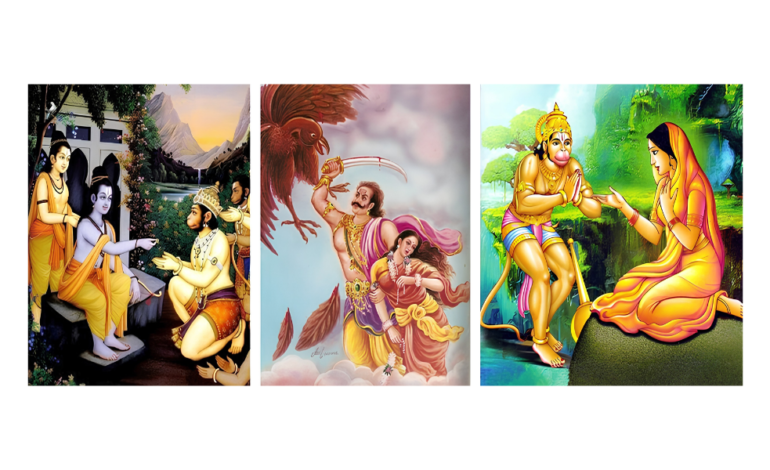
Rare episodes hidden in the Valmiki Ramayana

By: Rajendra Kapil
When Hanuman Mistook Mandodari for Sita
The search for Sita is one of the central episodes of the Sundara Kanda of the Valmiki Ramayana. While the Ramcharitmanas describes Hanuman’s search briefly, Valmiki gives a much more detailed account of what Hanuman saw and the thoughts that passed through his mind.
In the Ramcharitmanas, Tulsidas writes:
मंदिर मंदिर प्रति करि सोधा,
देखे जहँ तहँ अगनित जोधा
गयउ दसानन मंदिर मॉहीं,
अति बिचित्र कहि जात सो नाहीं
सयन किए देखा कपि तेहि,
मंदिर महूँ न दिखि बैदेही
Meaning:
Hanuman searched every palace and chamber and saw countless warriors. He entered Ravana’s magnificent palace and saw Ravana sleeping, but Sita, the daughter of King Janaka, was nowhere to be found.
Hanuman had never seen Sita before. He had no portrait or image of her, only the description he had been given: a beautiful, graceful and sorrowful princess devoted completely to Rama. He therefore had to rely on that mental image as he searched Lanka.
Inside Ravana’s Palace
In Ravana’s royal residence, Hanuman saw the mighty king sleeping on a magnificent bed, richly adorned and covered with sandalwood paste. Numerous women lay sleeping around him, apparently exhausted after a night of drinking and revelry.
Valmiki describes the scene in considerable detail:
सु-काण्ड – 10/9, 10, 11
वृतमांभरणेदिव्येः सुरूपं कामरूपिणम् ॥
सवृक्षवनगुरमाद्ं प्रसुप्तमिव मन्दरम् ॥ ९ ॥
करीडित्वोपरतें रात्रौ वराभरणभूषितम् ॥
श्रियं राक्षसकन्यानां राक्षसानां सुखावहम् ॥ १० ॥
पीत्नाऽप्युपरतं चापि ददशं स महाकपिः ॥
भाखरे शयने वीरं प्रसुप्तं राक्षसाधिपम् ॥ ११ ॥
Meaning:
Hanuman saw Ravana sleeping like the mighty Mount Mandara, adorned with splendid ornaments. After spending the night in pleasure and revelry, Ravana lay asleep on his magnificent bed.
Valmiki then describes the women around him:
काचिदाडम्बरं नारी यजसंभोगपीडितम् ॥
कत्वा कमलपत्राक्षी प्रसु्ना मदमोहिता ॥ ४५॥
Meaning:
One lotus-eyed woman lay exhausted and overcome by intoxication after the night’s revelry.
Elsewhere, Hanuman saw women sleeping in various postures:
अन्या कक्षगतेनैव मङ्केनापितेक्षणा ॥
प्रशुक्ा भामिनी भाति बालपुत्रैव वत्सला ॥३८॥
Meaning:
Another beautiful woman appeared to be sleeping peacefully and affectionately, like a mother embracing her young child.
And:
कैचिदटंशं परिष्वज्य सुप्रा कमरुलीचना ॥
रहः प्रियतमं गृ सकौमेव च कामिनी ॥ ४० ॥
Meaning:
One woman, with beautiful eyes, lay asleep while embracing Ravana’s arm, appearing like a woman resting close to her beloved.
When Hanuman Mistook Mandodari for Sita
Then Hanuman saw a particularly beautiful woman near Ravana. She was fair, graceful and richly adorned.
She was Mandodari, Ravana’s chief queen. But Hanuman did not know this. For a moment, he believed he had found Sita.
सु-काण्ड – 10/52, 53
गोरं कैनकवणोज्गीमिष्टामन्तःपुरेशवरीम् ॥
कपिमन्दोदरी तत्र शयानां चाररूपिणीम् ॥ ५२ ॥
स तां दृष्ट्रा महाबाहुभूषितां मारुतात्मजः ॥
तकेयामास सीतेति रूपयौवनसंपदा ॥
हर्षेण महता युक्तो ननन्द हरियूथपः ॥५३॥
Meaning:
Hanuman saw a fair-complexioned and extraordinarily beautiful woman, the chief queen of the inner palace, sleeping adorned with magnificent ornaments. Seeing her beauty and youth, the son of the Wind-god thought that she was Sita. Filled with joy, Hanuman rejoiced at the thought that he had finally found her.
But Hanuman soon reconsidered.
Why She Could Not Be Sita
He reasoned that Sita, separated from Rama, could never be found intoxicated or participating in the pleasures of Ravana’s palace. Nor would she willingly approach another man.
सुन्दरकाण्ड – सर्ग 11/2, 3, 4
न रामेण वियुक्ता सा खघुमति भामिनी ॥
न भोक्त नाप्यरंकै न पानशुपसेवित् ॥ २॥
नान्यं सरगुपसातुं सुराणामपि चेश्वरम् ॥
न हि रामसमः कथिद्धियते त्रिदशेष्वपि ॥ ३ ॥
अन्येयमिति निधि वीनभूमो चचार सः ॥
पान भूमो हरि श्रेष्ठ: सीता संदर्श नो उत्सुक: ॥ ४ ॥
Meaning:
Hanuman thought: Sita, separated from Rama, could never be found in such a condition. She would neither drink nor indulge in worldly pleasures. She would never approach another man, even if he were a powerful celestial being. There was no one equal to Rama.
He therefore concluded that the woman he had seen was someone else and continued his search.
Hanuman’s Concern About Dharma
The experience also led Hanuman to examine his own conduct. He had seen many women in Ravana’s private chambers and wondered whether this could constitute a violation of his dharma.
परदारावरोधख प्रसुप्रख निरीक्षणम् ॥
इदं खल ममादय्थं धर्म लोपम करिष्यति ॥ ३६ ॥
काममं दृष्टा मया सर्वा विश्वस्ता रावण स्त्रीय: ॥
न तु मे मनसा किंचिद वैकृत्यम उप पद्यते ॥ ३९ ॥
Meaning:
“Have I violated my dharma by observing the wives of another man in his private chambers? I have seen all these women, but my mind has not been disturbed by desire or improper thoughts.”
Hanuman concluded that his purpose had remained pure. He was there solely to find Sita, and his mind had never strayed from that mission.
The House of Vibhishana
Continuing his search, Hanuman came upon a house that stood apart from the others. It bore symbols associated with Lord Rama, and fresh Tulsi plants grew outside.
It was the house of Ravana’s younger brother, Vibhishana.
The Ramcharitmanas describes the sight:
रामायुध अंकित गृह। सोभा बरनि न जाई
नव तुलसिका वृन्द तहँ, देखी हरविष कपिराई
Meaning:
The house was marked with the symbols of Lord Rama, and its beauty was beyond description. Fresh Tulsi plants grew there. Seeing them, Hanuman was filled with joy.
Hanuman met Vibhishana and explained that he had come as Rama’s messenger in search of Sita. Vibhishana welcomed him and told him that he had opposed Ravana’s abduction of Sita and had repeatedly advised his brother to return her to Rama. Ravana, however, refused to listen.
This meeting became a crucial turning point in Hanuman’s search.
The episode of Hanuman mistaking Mandodari for Sita is significant not merely as an unusual moment in the Ramayana, but because it reveals Hanuman’s extraordinary self-awareness. Even while searching through Ravana’s palace, he questioned his own perceptions and conduct, corrected his mistake through reason, and remained unwavering in his devotion to Rama and his mission to find Sita.