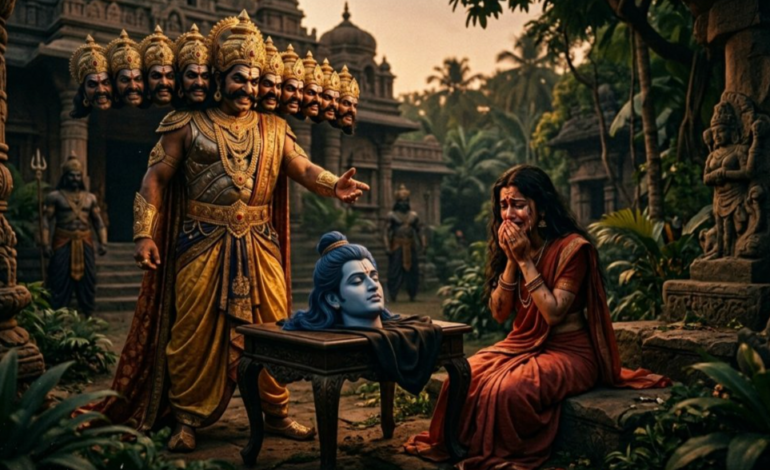
Rare episodes hidden in the Valmiki Ramayana: Did Ravana meet Sita in a previous birth?

By: Rajendra Kapil
According to the Valmiki Ramayana, the answer to the above question is yes. This episode is not described in the Ramcharitmanas, but it is mentioned in detail in the seventeenth canto of the Uttara Kanda of the Valmiki Ramayana.
In this canto, Sage Agastya narrates a story from Ravana’s youth.
According to the story, once during his younger days, Ravana was wandering near the Himalayas. There he saw an extraordinarily radiant young woman deeply immersed in penance. She was wearing a black deer skin over her body, and her beauty was incomparable. The moment Ravana saw this beautiful ascetic maiden, he became restless with desire to possess her. Lust and infatuation overtook him. Her name was Vedavati.
Sa drishtva roopa-sampannaam kanyaam taam su-mahaa-vrataam ।
Kaama-moha-paritaatma papraccha prahasanniva ॥ 3 ॥
Ravana approached her and began speaking in a persuasive manner:
“O beautiful one, such severe penance at this young age does not suit you. Your beauty is divine. You should rule over the hearts of young men.”
Kasyaasi kimidam bhadre kashcha bhartaa varaanane ।
Yena sambhujyase bheeru sa narah punya-bhaag bhavet ॥ 6 ॥
“O graceful lady, tell me about yourself. Whose daughter are you? Why are you performing such severe austerities? Is there some man who is your husband? What do you hope to achieve through this penance?”
Hearing this, Vedavati rose respectfully and welcomed him as a guest. She offered him a proper seat and replied:
Kushadhvaja naama pitaa brahmarshir-amita-prabhah ।
Brihaspati-sutah shreemaan buddhyaa tulyo Brihaspateh ॥ 8 ॥
Tasyaaham kurvato nityam vedaabhyaasam mahaatmanah ।
Sambhootaa vaangmayee kanya naamnaa Vedavati smritaa ॥ 9 ॥
“My father was the great sage Kushadhwaja, son of Brihaspati, the guru of the gods. He was highly revered among sages and equal to Brihaspati in wisdom. My name is Vedavati.
When I came of age, many gods, Gandharvas, and Yakshas sought my hand in marriage, but my father refused them all. Instead, he dedicated himself to training me in austerity and spiritual discipline. He desired only one husband for me — Lord Vishnu Himself.”
When the proud demon king Shambhu learned of this, he became enraged.
Tena raatrau shayaane me pitaa paapena himsitah ॥ 14 ॥
Tato me jananee deenaa tachchhareeram pitur mama ।
Parishvajya mahaabhaagaa pravishtaa havya-vaahanam ॥ 15 ॥
“That sinful demon murdered my father while he slept at night. My mother, overcome with grief, embraced my father’s body and entered the funeral fire along with him. Thus, I was left alone.
From that day onward, I vowed that I would perform severe penance to fulfill my father’s wish. If I marry, it shall only be Lord Vishnu, ruler of the three worlds. Otherwise, I shall never marry. That is why I am engaged in this intense austerity.”
Hearing her noble words, Ravana became even more desperate to possess her. Filled with arrogance, he declared:
“I am the mighty king Dashagriva, lord of Lanka. Become my wife and enjoy all worldly pleasures with me. Why waste your youth in penance?”
Aham Lankaapatir-naama Dashagreeva iti shrutah ।
Tasya me bhava bhaaryaa tvam bhunkshva bhogaan yathaa-sukham ॥ 23 ॥
“Do you even know who this Vishnu is, whom you call the lord of the universe? Can he equal me in strength and glory? Have you ever even seen him? Is he as magnificent as I am?”
Vedavati was shaken by Ravana’s arrogance but replied firmly:
“No, I have not seen Lord Vishnu, but I can never think of anyone except Him. Narayana is the supreme lord of the universe. The whole world worships Him. My father could never be wrong. I belong to Vishnu alone, and to Him alone I shall remain devoted.”
Hearing this, Ravana became furious. He seized Vedavati by her hair and violently shook her. Then, drawing his sword, he cut off her hair.
Tato Vedavati kruddhaa keshaan hastena saacchinat ।
Asi-bhootvaa karastasyaah keshaan chhitvaa nyavartata ॥
Saa jvalantee iva roshena dahantee iva nishaacharam ।
Uvaachaagnim samaadhaaya maranaaya krita-tvaraa ॥ 29 ॥
Burning with rage, Vedavati assumed a fierce form and thundered:
“O wicked demon! You have insulted me and tried to dishonor me. I will never belong to you. This body now feels impure to me. I no longer wish to live. I shall enter the fire before your eyes. But before I go, I warn you — in my next birth I shall meet you again and become the cause of your death.”
Yasmaat tu dharshitaa chaaham tvayaa paapaatmanaa vane ।
Tasmaat tava vadhaartham hi samutpatsyaamyaham punah ॥ 31 ॥
Nahi shakyah striyaa hantum purusha paapa-nishchayah ।
Shaape tvayi mayotsrishte tapasashcha vyayo bhavet ॥ 32 ॥
“A woman may not possess the physical strength to destroy a sinner like you directly. If I curse you, the fruits of my penance would be wasted. Therefore, I depart now, but I shall soon return in another birth.”
Saying this, Vedavati entered the sacred fire, and flowers rained down from the heavens.
Later, King Janaka was ploughing the earth near his palace when his plough struck something in the ground. There appeared a young girl. She was first called Bhumija, meaning “born from the earth.” Later, her parents named her Sita.
In time, Sita’s swayamvara was held, where Lord Rama, prince of Ayodhya, fulfilled the challenge and won her hand in marriage.
But destiny had not yet completed Vedavati’s vow.
During their exile in the forest, Ravana once again heard of Sita’s extraordinary beauty. Overcome with the same desire that had consumed him in his youth, he abducted her from Panchavati with the help of Maricha and took her to Lanka.
By then, Sita’s first wish — attaining Lord Vishnu (Rama) as her husband — had already been fulfilled. But her second vow still remained: to become the cause of Ravana’s destruction.
Lord Rama repeatedly offered peace to Ravana, but Ravana refused every proposal. He also tried many times to persuade Sita to become his queen, but she rejected him each time.
Eventually, Lord Rama fought Ravana to rescue Sita, and thus Sita became the ultimate cause of Ravana’s downfall and death.
This is one of the rare hidden episodes found in the Valmiki Ramayana — a story seldom discussed elsewhere.
“Jai Shri Ram”