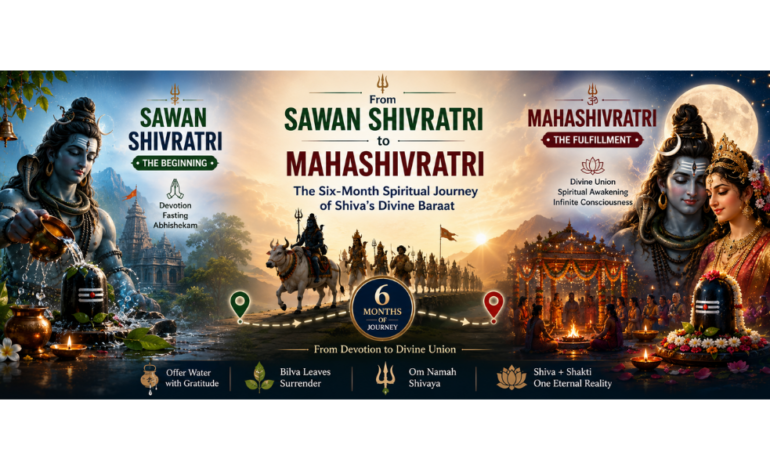
From Sawan Shivratri to Mahashivratri: The six-month spiritual journey of Shiva’s divine Baraat

Two Sacred Nights, One Spiritual Journey from Devotion to Divine Union
For millions of devotees, Sawan Shivratri and Mahashivratri are two of the most sacred occasions dedicated to Lord Shiva. Sawan Shivratri falls during the holy month of Shravan, while Mahashivratri arrives roughly six lunar months later. Both are marked by fasting, night-long prayers, chanting of Om Namah Shivaya and Abhishekam of the Shiva Lingam.
A beautiful devotional tradition connects the two through the story of Shiva’s divine Baraat—his extraordinary wedding procession to Goddess Parvati.
It is important to note that the idea of Shiva beginning his Baraat on Sawan Shivratri and reaching Parvati exactly six months later on Mahashivratri is best understood as a popular devotional or regional tradition, rather than a universally established Puranic chronology. Yet its symbolism offers a profound way to understand the spiritual significance of these two sacred nights.
Why Shravan Is Sacred to Shiva
Shravan, one of the most auspicious months for Shiva worship, is a time of fasting, prayer, pilgrimage and spiritual discipline. Devotees observe Sawan Somwar, perform Rudrabhishek, offer Bilva leaves and undertake pilgrimages to Shiva temples.
Shravan is also associated with the legendary Samudra Manthan, when the deadly poison Halahala emerged from the cosmic ocean. To save creation, Shiva consumed the poison and held it in his throat, becoming Neelkanth—the Blue-Throated One.
The offering of water to Shiva during Shravan can therefore be understood as an expression of gratitude and devotion toward the Lord who, according to the sacred tradition, accepted the poison to protect the universe.
This connection is especially visible in the Kanwar Yatra, when millions of devotees carry sacred Ganga water and offer it to Shiva temples.
Sawan Shivratri: The Beginning of the Journey
Sawan Shivratri comes at the culmination of the Shravan observances and holds special importance for Shiva devotees.
According to the popular Baraat tradition, it marks the beginning of Shiva’s journey toward his divine marriage with Parvati.
Parvati, the daughter of Himavan and an incarnation of Sati, performed intense penance to win Shiva as her husband. Shiva eventually accepted her devotion.
But Shiva’s wedding procession was unlike any ordinary Baraat.
The bridegroom appeared covered in sacred ash, adorned with serpents and accompanied by Devas, Ganas, ascetics and mysterious beings. Shiva represented the Divine beyond conventional appearances and worldly expectations.
Parvati, however, saw beyond the unconventional appearance. She recognized the divine consciousness within him.
The story carries a timeless message: true devotion looks beyond external form and recognizes the Divine essence.
The Six-Month Journey
The popular devotional interpretation sees Sawan Shivratri as the beginning of Shiva’s journey and Mahashivratri as its fulfillment.
The six-month interval can be understood symbolically as a period of preparation, patience and spiritual transformation.
Just as devotees spend Shravan in prayer and discipline, the journey toward Mahashivratri represents the human journey from intention to realization, from seeking to finding, and from individual consciousness toward divine union.
Whether understood literally as a regional tradition or symbolically as a spiritual teaching, the six-month journey gives the Hindu calendar a beautiful devotional continuity.
Mahashivratri: The Great Night of Shiva
Approximately six lunar months later comes Mahashivratri—the Great Night of Shiva.
Among its many traditions, Mahashivratri is celebrated as the night of the divine marriage of Shiva and Parvati. Their union represents Shiva and Shakti—consciousness and divine energy.
Without Shakti, consciousness cannot manifest; without Shiva, energy lacks its eternal foundation. Their union therefore represents the harmony underlying creation itself.
Another important Mahashivratri tradition is the story of Lingodbhava.
According to this legend, Brahma and Vishnu once disputed their supremacy. Shiva appeared before them as an infinite pillar of light. Brahma searched for its top and Vishnu for its bottom, but neither could find its beginning or end.
The message is profound: the Supreme Reality is infinite and beyond human measurement.
The Shiva Lingam is therefore not merely an object of worship; for devotees, it represents the limitless, formless reality of Shiva.
Two Shivratris, One Spiritual Message
Seen together, Sawan Shivratri and Mahashivratri create a remarkable spiritual arc.
Sawan Shivratri comes at the end of Shravan—a month of devotion, purification, fasting, pilgrimage and surrender.
Mahashivratri, roughly six months later, becomes the Great Night associated with Shiva-Shakti, the infinite Jyoti, spiritual awakening and divine realization.
The six-month Baraat can thus be understood as a metaphor for life itself:
Every destination requires a journey.
Every realization requires preparation.
Every union requires surrender.
The Shiva-Parvati story also reminds us that seemingly opposite forces can complement one another. Shiva represents stillness and consciousness; Parvati represents Shakti, action and creative energy. Together they represent the completeness of existence.
For devotees, therefore, the journey from Sawan Shivratri to Mahashivratri is much more than a movement across the Hindu calendar.
It is a journey from devotion to realization, from discipline to fulfillment, and from seeking Shiva outside ourselves to discovering the Divine within.
Whether one views the six-month Baraat as regional tradition, oral legend or spiritual metaphor, its message remains timeless:
The journey toward the Divine requires faith, patience, discipline and surrender.
And when the journey reaches its destination, Shiva and Shakti are no longer two.
They are one eternal reality.