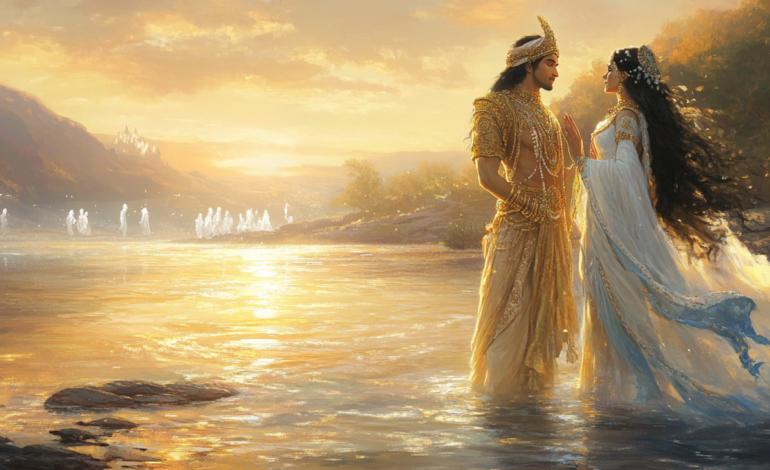
The great epic of the Mahabharata: The story of Shantanu and Ganga (1)

By: Rajendra Kapil
Today, we begin our journey through the great epic of the Mahabharata. As its name suggests, the Mahabharata is the story of a great nation, Bharat. It tells the story of the descendants of King Bharata, the son of Dushyanta and Shakuntala, after whom our country came to be known as Bharat.
It is the story of a land whose history gave birth to extraordinary personalities like Bhishma. It is also the story of a family in which love existed alongside the conflicts, rivalries and jealousies commonly found in human relationships. It portrays the blind attachment of a blind king and his queen toward their children. It brings together Lord Krishna and the wise, impartial Vidura. It tells us about powerful kings like Krishna, as well as poor Brahmins like Sudama, whose remarkable friendship remains without parallel.
The Mahabharata reveals the extreme limits of family rivalry, but it also presents Karna’s extraordinary and unconditional loyalty to his friend. It contains the episode of gambling and the deeply shameful incident in which a woman was staked and lost in a game of dice. It introduces us to warriors of unmatched courage, as well as helpless husbands who, despite being powerful and accomplished, find themselves unable to prevent injustice and sit defeated, holding their heads in despair.
It is the story of Arjuna, the world’s greatest archer, who hesitates and refuses to fight in the face of war. It is also the story of his remarkable charioteer, Lord Krishna, who not only held the reins of Arjuna’s horses but also guided the restless and despairing mind of humanity. The Mahabharata is the story of India, a land with a rich cultural and philosophical heritage that offered the world lessons in living a disciplined and dignified life. Through its account of family conflict, it also presents an enduring example of how balance, duty and responsibility can be maintained even in the most difficult circumstances.
But where does this great story begin?
It begins with the love story of King Shantanu and Goddess Ganga.
One day, King Shantanu of Hastinapur went hunting. While wandering along the banks of the River Ganga, he saw an exceptionally beautiful woman who looked like a celestial nymph. Her name was also Ganga. The king was captivated by her beauty and momentarily lost all awareness of himself. In reality, Ganga was a daughter of the celestial world of Brahmaloka who had come to earth because of a curse. Unable to contain his feelings, Shantanu approached her and expressed his love. Ganga, too, found the king attractive and was pleased with him.
After a brief conversation, Shantanu proposed marriage. Ganga accepted his proposal but placed one condition before him. She told him that after their marriage, he must never question or object to anything she did, whatever it might be. Shantanu considered this a simple condition. Ganga further warned him that the day he stopped her from doing anything or questioned her actions, she would leave him immediately.
Deeply in love, Shantanu agreed to all her conditions without giving them much thought. He brought Ganga to his palace, and they were married according to royal traditions.
Their married life was initially filled with happiness. Nearly two years later, a son was born to them, bringing joy throughout the kingdom. A few days after the birth, Ganga quietly took the infant in her arms and walked alone toward the River Ganga.
Shantanu saw her leaving but did not ask where she was going or why. He was bound by the promise he had made. Instead, he sent his attendants to follow her and find out what she intended to do. They returned with shocking news: Ganga had immersed their newborn son in the river.
When Shantanu heard what had happened, he was deeply distressed. Yet, he felt helpless because his promise prevented him from questioning his wife.
About a year later, Ganga gave birth to another son. A few days afterward, she once again carried the child to the river and immersed him in its waters. This continued over the years. One after another, seven sons were born to Shantanu and Ganga, and Ganga immersed all seven in the river.
Shantanu suffered silently. Countless questions troubled his mind, and the pain of losing each child grew unbearable. Yet, he remained bound by the promise he had made. He could neither question Ganga nor stop her. His inner conflict had reached its limit.
The following year, Ganga gave birth to their eighth son. When she once again began walking toward the river with the newborn in her arms, Shantanu could no longer restrain himself.
In deep anguish, he confronted her:
“What kind of mother are you? How can you silently immerse your newborn children in the river? Does it not cause you any pain? Does your motherly love not question what you are doing?”
Ganga stopped. She smiled gently and, remaining calm, said:
“King Shantanu, today you have broken your promise. You have saved this eighth child, but now I will reveal the secret behind these events.
“I am Ganga, the daughter of Lord Brahma. Because of a curse, I was sent to live on earth. These eight children were also the celestial Vasus from Brahmaloka, who had been cursed to take birth on earth. I had to free them from this curse. That is why I did what destiny had ordained.
“However, this eighth child has not been freed from the curse. He will live as your son. I grant him the blessing of Ichchha Mrityu—the power to choose the time of his death. He will not die until he himself wishes to do so.
“I name him Devavrata. Since he was born from my womb, the world will also know him as Gangaputra, the son of Ganga.”
After hearing the entire story, Shantanu experienced both happiness and sorrow. He was happy that he had saved at least one of his sons, but deeply saddened that he had broken the promise he had made to Ganga.
With a heavy heart, he asked her to forgive him. But Ganga replied:
“King Shantanu, I am now free from my curse and must return to Brahmaloka. I can no longer remain with you. I am taking this newborn child with me because he still needs his mother. After a few years, I will return and hand your son back to you.”
Having said this, Ganga disappeared with the infant.
Shantanu returned to his palace, overwhelmed by sadness. His heart was no longer in the affairs of the kingdom. Memories of Ganga constantly troubled him, and he often thought about the son who had been taken away. In this manner, sixteen years passed.
One day, as he stood in his palace looking toward the River Ganga, he suddenly noticed a woman and a young man standing on its banks.
Unable to contain his excitement, the king hurried toward them. As he approached, he recognized Ganga. Standing beside her was a handsome and graceful young prince.
After greeting Shantanu, Ganga said:
“Your Majesty, this is your son, Devavrata. I have raised him with the best care and guidance I could provide. He received his early education at the Gurukul of Sage Vashishtha, who imparted to him a profound knowledge of the scriptures and sacred teachings.
“Later, I sent him to the Ashram of Sage Parashurama to learn the art of warfare and the use of weapons. There, Lord Parashurama trained him to become an accomplished warrior. Today, he is prepared to face every challenge, whether small or great.
“His time in Brahmaloka has now come to an end, and he will remain with you from this day forward. I have fulfilled my promise. Please take care of him. He will become a source of pride and glory for your dynasty.”
King Shantanu was overwhelmed with joy at seeing his son, now a young and accomplished prince. Ganga, having fulfilled her promise, disappeared from their sight.
Thus, Devavrata returned to his father, Shantanu, marking the beginning of a new chapter in the history of the Kuru dynasty. In time, he would become one of the most remarkable and revered figures in the Mahabharata—known to the world as Bhishma.
The story continues in the next episode.
Jai Mahabharata!