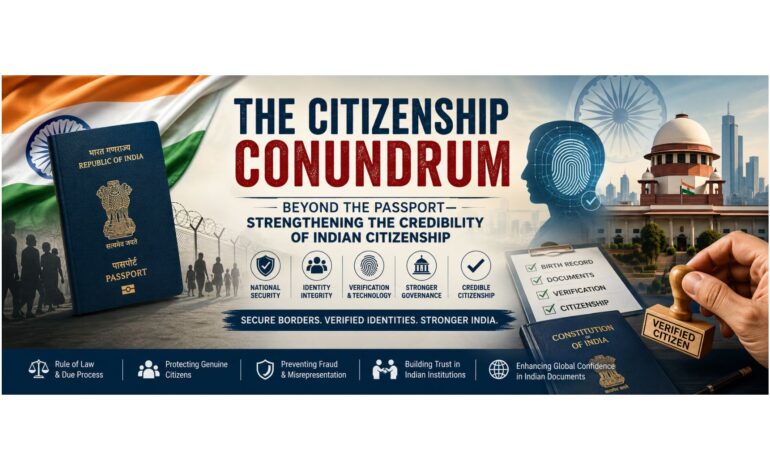
Analysis: The citizenship conundrum: Beyond the passport—strengthening the credibility of Indian citizenship

By: Dr. Avi Verma
The Ministry of External Affairs’ clarification did not emerge in a vacuum. It arrived at a time when India is simultaneously confronting concerns over illegal immigration, identity fraud, electoral integrity, border security, and the modernization of its citizenship records.
National media has largely viewed the announcement through three distinct lenses.
The first has been public confusion. Newspapers and television networks such as The Times of India, NDTV, The Hindu, and India Today highlighted widespread questions from ordinary citizens. If a passport, issued after extensive police verification, is not conclusive proof of citizenship, many wondered what document actually is. The discussion exposed a broader administrative reality: India has no single universally accepted “master document” establishing citizenship for every legal purpose.
The second lens has been the political debate. Reports connected the clarification with the ongoing revision of electoral rolls in some states and broader discussions over citizenship documentation. Opposition parties questioned the timing, arguing that it could create uncertainty among genuine citizens. Government representatives responded that the clarification merely reiterates existing law under the Passports Act and long-standing judicial interpretations. In other words, according to the government, nothing substantive has changed; only the legal position has been restated.
The third—and perhaps most significant—lens is national security, an aspect that deserves greater attention than it has received.
The national security dimension
For decades, India has faced persistent challenges arising from illegal immigration, forged identity documents, human trafficking networks, and cross-border infiltration, particularly along sensitive international borders. Security agencies have repeatedly uncovered instances where individuals obtained Aadhaar cards, voter identification cards, ration cards, and even passports using forged or fraudulently obtained supporting documents.
If a passport were treated as absolute and irreversible proof of citizenship, correcting such fraud would become significantly more difficult. The government’s clarification preserves the legal authority to investigate, revoke, or cancel a passport if subsequent evidence establishes that it was obtained through misrepresentation or false documentation.
From a national security perspective, this distinction strengthens—not weakens—the integrity of the passport system. It reinforces the principle that citizenship is a legal status established under the Constitution and the Citizenship Act, while the passport remains an administrative document issued on the basis of available evidence.
As India expands the use of biometric databases, facial recognition, artificial intelligence, and integrated digital governance, maintaining this legal distinction provides authorities with flexibility to combat identity fraud without undermining constitutional due process.
Is this a step toward controlling illegal immigration?
While the MEA did not explicitly link its clarification to illegal immigration, the broader policy direction suggests a tightening of identity verification.
India has increasingly emphasized border management, digital identity verification, biometric databases, and improved documentation standards. Together, these initiatives seek to reduce opportunities for illegal entrants to regularize their status through fraudulent documentation.
The clarification effectively signals that possession of a passport cannot permanently shield an individual from later scrutiny if credible evidence raises questions about the legitimacy of the underlying citizenship claim.
For enforcement agencies, this represents an important legal safeguard.
For genuine citizens, however, it also highlights the need for transparent procedures and robust safeguards so that administrative reviews do not become arbitrary or burdensome.
Enhancing the credibility of Indian citizenship
Perhaps the most important long-term implication is the credibility of Indian citizenship itself.
Every sovereign nation has both the right and the responsibility to determine who its citizens are. As India emerges as a major global economic and geopolitical power, the value of its citizenship carries increasing international significance.
A citizenship system that can be manipulated through fraudulent documentation ultimately weakens national security, burdens public services, undermines electoral confidence, and diminishes the credibility of Indian travel documents abroad.
Viewed from this perspective, stricter verification mechanisms should not be seen merely as enforcement tools but as measures that strengthen the integrity of citizenship itself.
However, stronger verification must be accompanied by stronger administrative capacity. India cannot expect citizens to navigate decades-old paper records, inconsistent birth registrations, and fragmented databases indefinitely. A modern economy requires a modern citizenship infrastructure.
The way forward
The debate should therefore move beyond the narrow question of whether a passport proves citizenship.
The larger challenge is whether India can build an integrated, transparent, and legally robust civil registration system that protects genuine citizens while preventing fraud.
Such a system would enhance national security, improve governance, reduce litigation, strengthen international confidence in Indian documents, and make it easier for citizens to establish their legal status without unnecessary bureaucratic hurdles.
The MEA’s clarification may appear technical, but it reflects a larger transition underway. India is gradually moving from a document-based administrative model toward a verification-based governance system. That transition will inevitably generate debate. The challenge for policymakers is to ensure that the pursuit of security strengthens, rather than complicates, the rights and confidence of India’s law-abiding citizens.
Ultimately, the credibility of Indian citizenship depends not only on who receives a passport, but on the integrity, transparency, and fairness of the entire system that stands behind it.