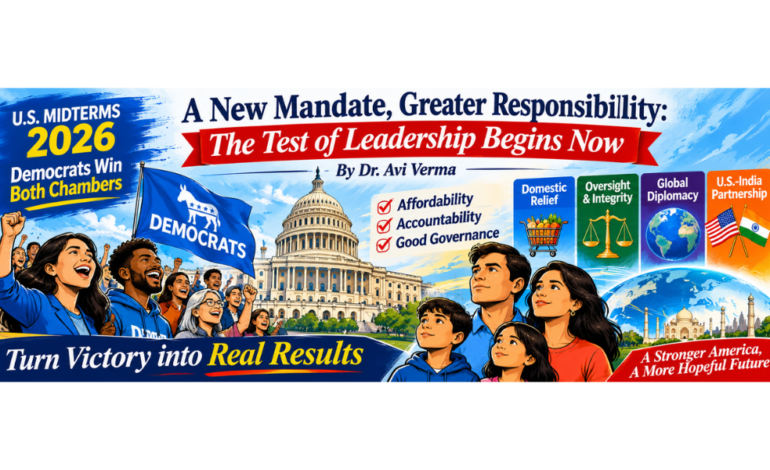
A new mandate, greater responsibility: The test of leadership begins now

By: Dr. Avi Verma
The November 3, 2026, midterm elections have delivered a major political setback to President Donald Trump and the Republican Party. Democrats have secured control of both chambers of Congress, turning what was expected to be a competitive midterm into a sweeping electoral victory. In Illinois, Governor J.B. Pritzker won an unprecedented third term, and Lieutenant Governor Juliana Stratton was elected to the U.S. Senate.
The results reflect voter concerns over affordability, immigration enforcement and the direction of national leadership. But an election victory is not a blank cheque. It is an opportunity—and an obligation—to govern responsibly. For the new Democratic majority, the real test begins now.
A Historic Moment for Illinois
Illinois has emerged as an important part of the Democratic victory. Stratton’s election to succeed retiring Senator Dick Durbin creates a historic milestone: she will serve alongside Senator Tammy Duckworth, making Illinois the first state represented simultaneously by two women of color in the U.S. Senate.
Democrats also maintained control of the Illinois legislature and their 14–3 advantage in the state’s U.S. House delegation. New representatives, including Daniel Biss and Melissa Bean, will bring fresh voices to Congress.
This political continuity gives Illinois Democrats considerable influence in Washington and Springfield. The responsibility now is to convert that influence into results for residents.
The Domestic Priority: Relief for American Families
The cost of living remains a major concern for American households. Families continue to face pressure from grocery bills, housing, healthcare, energy, insurance and everyday expenses.
The new Congress must make affordability its central priority. It should pursue practical measures that strengthen employment, improve access to healthcare, encourage economic growth and ease the financial burden on working families.
Inflation cannot be addressed through political rhetoric alone. Congress must work with the administration, businesses and state governments to tackle the underlying pressures affecting household budgets.
In Illinois, Governor Pritzker’s third term must address property taxes, public safety, education, infrastructure, state finances and economic opportunity. The state’s economic strength must translate into tangible benefits for ordinary families and small businesses.
Oversight Without Political Warfare
With Democrats controlling both chambers of Congress, scrutiny of the Trump administration will become a defining feature of national politics.
Congress has a constitutional duty to examine executive actions, investigate credible allegations of misconduct, oversee public spending and protect the separation of powers. That responsibility applies regardless of which party controls the White House.
However, oversight must be based on evidence, due process and constitutional principles—not political retaliation. Investigations should produce accountability, not become substitutes for legislation.
Americans are weary of partisan gridlock. Immigration reform, healthcare, infrastructure, taxation and national security require a functioning Congress. The new majority must demonstrate that it can hold the administration accountable while still delivering meaningful legislation.
A Fractured World: Diplomacy and Strategic Clarity
The international environment presents difficult choices. The wars in Ukraine and the Middle East, tensions involving Iran, competition with China and uncertainty over global trade require careful judgment.
Ukraine: Congress must evaluate military assistance, humanitarian support and diplomatic initiatives while considering the security interests of the United States and its European allies. Support for national sovereignty should be accompanied by clear objectives, accountability and a realistic path toward peace.
Iran and the Middle East: Washington must avoid an open-ended military confrontation. Protecting American and regional security requires credible deterrence, coordination with allies and serious diplomatic efforts to prevent escalation.
Israel and Gaza: America’s commitment to Israel’s security remains important. At the same time, U.S. policy and military assistance must be subject to appropriate oversight, with attention to civilian protection, humanitarian access and a sustainable political settlement. Israel’s security and the legitimate aspirations of Palestinians for dignity and security must both remain part of the discussion.
The new Congress should approach these challenges through informed debate and bipartisan engagement, not domestic political calculations.
India and the Indo-U.S. Strategic Partnership
For India and the Indian American community, the election carries important implications. The U.S.-India relationship has developed under administrations of both parties, supported by cooperation in defense, technology, education, trade and Indo-Pacific security.
This bipartisan foundation must be preserved. India is not simply a counterweight to China; it is an independent global partner with its own strategic interests and diplomatic priorities.
Three areas deserve particular attention:
Immigration: H-1B visas, employment-based immigration, green-card backlogs and policies affecting international students remain major concerns for Indian professionals, families and technology companies. Fair and predictable immigration policies benefit both the Indian American community and America’s economic competitiveness.
Trade and technology: Cooperation in artificial intelligence, semiconductors, cybersecurity, advanced manufacturing and critical technologies can create opportunities for businesses and workers in both countries. Trade disagreements should be addressed through negotiation rather than measures that weaken long-term confidence.
Defense and regional security: Cooperation in defense, maritime security and the Indo-Pacific serves shared interests. Washington must also respect India’s strategic autonomy and recognize that partnership does not require identical positions on every international issue.
For Indian Americans, this relationship is not merely diplomatic. It affects professional opportunities, family connections, education, investment and the future of the next generation.
The Real Measure of Victory
The 2026 midterms have changed who controls Congress. They have not eliminated America’s divisions, resolved its economic pressures or simplified its foreign-policy challenges.
The Democratic majority will be judged not by political rhetoric or the number of investigations it launches, but by the quality of its legislation, the integrity of its oversight and its ability to address the concerns of ordinary Americans.
At home, people need affordability, opportunity and confidence in their institutions. Abroad, America needs a foreign policy that protects its interests while recognizing the importance of diplomacy and international stability.
The IndoUS Tribune believes the central question after this election is not simply who won political power, but how that power will be exercised. Democracy is strengthened when elected leaders govern with restraint, transparency and accountability.
The mandate has been delivered. The responsibility to deliver results now belongs to those elected.