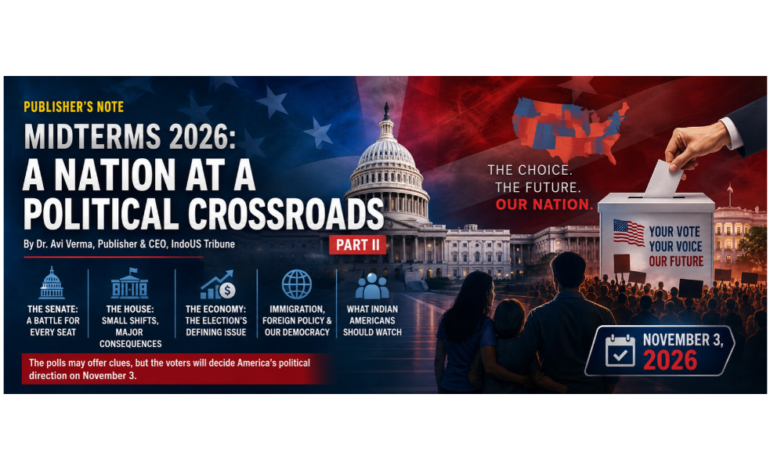
Midterms 2026: A Nation at a Political Crossroads — Part II

By: Dr. Avi Verma, Publisher & CEO, IndoUS Tribune
As America approaches the November 3, 2026, midterm elections, the battle for control of Congress is intensifying. The central question is whether Republicans can retain their narrow majorities or Democrats can shift the balance of power during the final two years of President Donald Trump’s second term.
In Part I, we examined the national political landscape and the implications of a possible change in congressional control. This installment focuses on the competitive races, the issues influencing voters and what the election could mean for the country.
The Senate: A Battle for Every Seat
The Senate contest could prove decisive in determining how much room the Trump administration has to advance its legislative agenda. Democrats face the challenge of gaining enough seats to secure a majority, while Republicans must defend vulnerable incumbents and prevent Democratic gains across competitive states.
Kansas, New Hampshire and North Carolina have drawn particular attention as potentially important contests. Kansas is significant because it has traditionally leaned Republican, while New Hampshire has a history of competitive statewide elections. North Carolina remains a closely watched battleground where candidate appeal and turnout could prove decisive.
The outcome will depend on more than party loyalty. Candidates’ records, local economic conditions, campaign organization and the national political climate will all influence voters. Neither party can assume that favorable polling trends will translate automatically into victories.
The House: Small Shifts, Major Consequences
The House of Representatives may offer Democrats their clearest opportunity to gain congressional control. Because House elections are decided district by district, a relatively small number of competitive races could determine the majority.
Republicans must persuade voters that the administration’s policies are producing meaningful results. Democrats, meanwhile, must demonstrate that they can offer practical alternatives rather than simply oppose the president.
A Democratic House majority would provide greater control over committees, investigations and legislative priorities. Republican control would preserve the administration’s congressional advantage, although narrow margins could still make legislation difficult to pass.
The Economy: The Election’s Defining Issue
For many Americans, the most important political question is straightforward: Can their families afford to live comfortably?
Grocery bills, housing, health insurance, transportation and education costs continue to shape household decisions. Small-business owners are also watching labor expenses, consumer demand, trade policy and economic uncertainty.
According to Pew Research Center’s October 2026 survey, 84% of registered voters considered the economy very important to their midterm vote. The future of democracy, health care and education also ranked highly among voters’ concerns.
Republicans will emphasize their approach to taxation, energy, regulation and economic growth. Democrats will focus on affordability and the administration’s economic record while advancing their own proposals.
Ultimately, voters are likely to judge both parties by whether their policies improve everyday life. Economic growth means little to families who feel that rising expenses continue to outpace their incomes.
Immigration and Foreign Policy Matter
Immigration remains an important dividing line. Republicans generally emphasize border security and enforcement, while Democrats often stress due process, enforcement priorities and the effects of immigration policy on families and employers.
For Indian Americans, these debates have particular relevance. Employment-based visas, family reunification, skilled-worker recruitment and the treatment of legal immigrants can affect families, businesses and educational institutions. Candidates should address these concerns with practical proposals rather than campaign slogans.
Foreign policy also carries domestic consequences. Tensions involving Iran, uncertainty in energy markets and questions about America’s international commitments can affect national security, fuel prices and federal spending. Americans deserve clear explanations of the objectives and costs of overseas military involvement.
Equally important is public confidence in democratic institutions. Transparent government, respect for the law, credible elections and the peaceful transfer of power are essential principles that transcend party politics.
What Indian Americans Should Watch
Indian Americans are a diverse electorate with varied political views and priorities. Economic opportunity, education, health care, public safety, immigration policy, small-business conditions and U.S.-India relations may all influence their choices.
No single party represents every interest within the community. Voters should examine candidates’ records, compare policy proposals and consider how decisions in Washington may affect their families and future generations.
At IndoUS Tribune, we believe informed participation matters more than automatic loyalty to any political party. Constructive engagement with elected representatives and careful evaluation of public policy help ensure that community concerns receive attention.
Polls Are Not the Final Verdict
National polling can identify broad trends, but individual races often produce unexpected results. Local issues, candidate credibility, turnout and the participation of independent voters can change the outcome.
Republicans must convince voters that their policies are delivering results. Democrats must demonstrate that they can translate public dissatisfaction into effective leadership and responsible governance.
A change in congressional control would reshape Washington’s political dynamics, but it would not automatically resolve the country’s challenges. The ability of elected officials to negotiate, exercise oversight and address public concerns would remain critical.
At IndoUS Tribune, our responsibility is to examine these developments fairly and provide readers with context beyond partisan rhetoric.
In Part III of this series, we will explore what a change in congressional control could mean for the economy, immigration, health care, federal spending and America’s foreign policy.
The polls may offer clues, but the voters will decide America’s political direction on November 3.