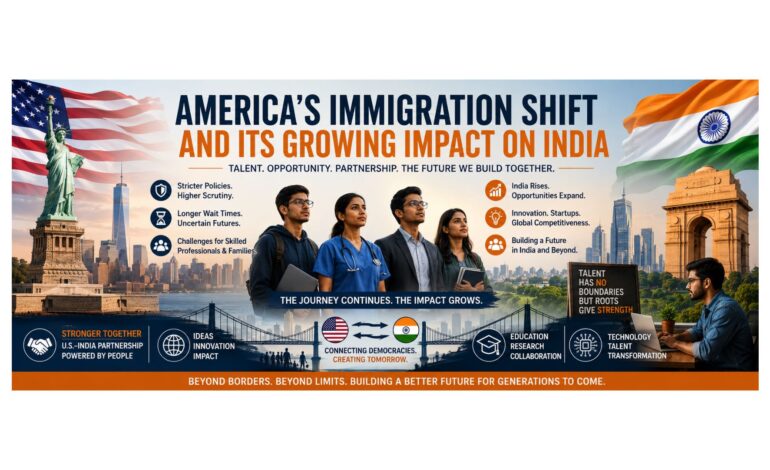
America’s immigration shift and its growing impact on India

By: Dr Avi Verma
For decades, the United States represented the ultimate destination for India’s brightest minds. Engineers, doctors, scientists, entrepreneurs, researchers, and students viewed America not merely as a land of opportunity, but as a partner in their aspirations. Indian talent helped build Silicon Valley, strengthened American healthcare, advanced scientific research, and contributed significantly to the growth of the U.S. economy. At the same time, these success stories strengthened India’s global reputation and forged one of the most important people-to-people relationships in the world.
Today, however, America’s immigration system is undergoing a fundamental transformation, and India is among the countries most affected by these changes.
Over the past decade, U.S. immigration policy has shifted from an emphasis on expanding economic opportunity and humanitarian admissions toward a framework increasingly focused on national security, border control, economic self-sufficiency, and enforcement. Successive administrations have relied heavily on executive actions, regulatory changes, enhanced vetting procedures, and administrative reforms rather than comprehensive congressional legislation.
For India, the most immediate impact has been felt in the area of skilled immigration.
Indian professionals account for the majority of H-1B visa holders in the United States. Thousands of Indian engineers, software developers, healthcare professionals, researchers, and technology specialists arrive in America each year to fill critical workforce needs. Increased scrutiny of employment-based visas, evolving eligibility requirements, longer processing times, and uncertainty surrounding dependent work authorization have created challenges for both employers and employees.
The effects extend well beyond individual workers. India’s technology industry has grown alongside America’s innovation economy for more than three decades. Major Indian technology companies built business models around serving U.S. clients, while American companies increasingly relied on Indian talent to remain globally competitive. As immigration policies tightened, many organizations adjusted by increasing local hiring in the United States while simultaneously expanding operations in India. Ironically, some restrictions intended to reduce dependence on foreign labor have accelerated the growth of India’s domestic technology ecosystem.
Cities such as Bengaluru, Hyderabad, Pune, Chennai, and Gurugram have emerged as global innovation hubs. Today, many highly skilled Indian professionals who once viewed relocation as the only path to career growth can increasingly find world-class opportunities within India itself. The rise of artificial intelligence, remote work, cloud computing, and global digital collaboration has further reduced the necessity of physical migration for many knowledge workers.
Another area of concern is higher education. Indian students now represent one of the largest international student populations in the United States. They contribute billions of dollars annually to American universities and local economies while strengthening educational and research ties between the two democracies. Yet uncertainty surrounding post-graduation employment opportunities, work visas, and green card pathways has encouraged some students to consider alternative destinations such as Canada, Australia, the United Kingdom, and Singapore.
Perhaps the greatest challenge remains the employment-based green card backlog. Tens of thousands of highly skilled Indian professionals who have followed every legal requirement continue to face years—sometimes decades—of waiting before obtaining permanent residency. For many families, this uncertainty affects career decisions, home ownership, education planning, and long-term financial security. The issue has become one of the most significant unresolved challenges in the U.S. immigration system.
At the same time, India’s growing economic strength is changing the conversation. The country is no longer simply a supplier of talent to developed economies. India is emerging as a major innovation center, startup powerhouse, manufacturing destination, and digital economy in its own right. Government initiatives promoting entrepreneurship, digital infrastructure, semiconductor manufacturing, and advanced technology are creating opportunities that did not exist a generation ago.
This does not diminish the importance of U.S.-India mobility. On the contrary, the strategic partnership between the world’s oldest and largest democracies depends heavily on the free exchange of talent, ideas, research, and entrepreneurship. Immigration is no longer just a domestic American issue; it has become a vital component of the broader economic and strategic relationship between the two nations.
The challenge for policymakers in Washington is to protect national interests while ensuring that America remains the world’s premier destination for global talent. The challenge for India is equally significant: to create an environment where its best minds can thrive whether they choose to build their futures at home or abroad.
As America debates the future of immigration, India must recognize an emerging reality. The measure of national success is no longer how many talented citizens leave for opportunities overseas. Increasingly, it is how many choose to stay, return, invest, innovate, and build the future of India itself.
The story of immigration between India and the United States is no longer simply about movement across borders. It is about talent, innovation, economic competitiveness, and the evolving relationship between two nations whose futures are becoming increasingly interconnected.
— The Publisher