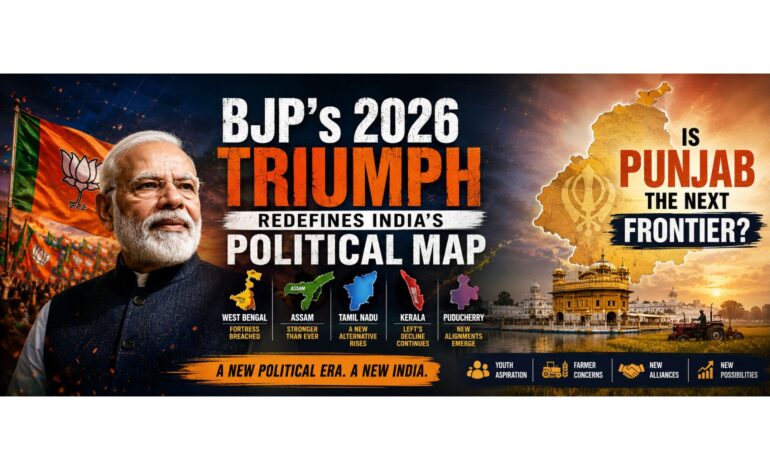
BJP’s 2026 triumph redefines India’s political map — is Punjab the next frontier?

By: Dr Avi Verma
The 2026 Assembly election results will likely be remembered as one of the most transformative political moments in contemporary Indian history. The verdicts from West Bengal, Tamil Nadu, Assam, Kerala, and Puducherry have not merely changed governments — they have fundamentally altered the psychology of Indian politics.
The Bharatiya Janata Party deserves congratulations for achieving what many once considered politically impossible: breaching entrenched regional strongholds and redefining the electoral geography of India. Its historic victory in West Bengal, coupled with a commanding repeat performance in Assam, signals that the BJP is no longer confined to its traditional Hindi-heartland base. It is now positioning itself as a truly pan-Indian political force.
The fall of Mamata Banerjee after 15 years in power is symbolic of a broader national trend: voters are increasingly impatient with political stagnation, corruption allegations, dynastic structures, and personality-driven regional dominance. The BJP’s victory in Bengal was built not merely on ideology, but on organization, booth-level expansion, targeted social engineering, and the ability to convert anti-incumbency into a disciplined electoral machine.
Equally important was the party’s emphatic victory in Assam under Himanta Biswa Sarma. The Northeast now appears firmly aligned with the BJP’s development-plus-identity narrative. A third consecutive mandate demonstrates that governance stability, infrastructure expansion, and assertive leadership continue to resonate strongly with voters.
Yet perhaps the most intriguing story of 2026 emerged from Tamil Nadu, where actor-politician Vijay and his party TVK disrupted six decades of Dravidian bipolar politics. His rise reflects a growing national appetite for political alternatives that appear “clean,” youthful, and outside entrenched political families. This development should concern every traditional regional party across India.
For the opposition bloc nationally, the 2026 elections expose a deeper structural crisis. The decline of the Left in Kerala and the collapse of the Trinamool Congress in Bengal indicate that regional parties can no longer rely solely on emotional identity politics or historical loyalties. Voters increasingly expect performance, credibility, and organizational agility.
But the real political question now shifts to 2027 — and particularly to Punjab.
Punjab may become the BJP’s next major experiment in independent expansion. For decades, the party functioned as a junior ally to the Shiromani Akali Dal. However, the Bengal breakthrough appears to have convinced BJP strategists that even seemingly resistant political landscapes can eventually be transformed through long-term cadre building, digital outreach, and targeted social alliances.
The political environment in Punjab today presents both volatility and opportunity. The growing dissatisfaction with governance, internal instability within the ruling establishment, economic distress, drug-related concerns, farmer anxieties, and increasing reports of political defections have created an atmosphere of uncertainty. The BJP appears determined to capitalize on this vacuum by expanding beyond its urban Hindu voter base and reaching deeper into Dalit, Sikh, youth, and first-time voter constituencies.
If the BJP succeeds in establishing itself as a credible standalone force in Punjab, it would represent one of the most significant political realignments in post-independence northern India.
At the same time, the BJP must recognize that Punjab is not merely another electoral battleground. Punjab’s political consciousness is deeply rooted in faith, federal identity, agrarian concerns, and emotional memory. Any attempt at expansion will require sensitivity, inclusive dialogue, and credible local leadership rather than overreliance on central narratives alone.
The 2026 verdicts also reveal another undeniable reality: elections in India are now digital-first wars. AI-driven localized messaging, hyper-targeted outreach, influencer ecosystems, and rapid narrative control are becoming decisive instruments of political success. Traditional campaign structures alone are no longer sufficient.
For the Congress and regional parties, the message from 2026 is stark. Reinvention is no longer optional. The old formulas of caste arithmetic, populist announcements, and legacy leadership are rapidly losing effectiveness in an electorate increasingly driven by aspiration, nationalism, governance expectations, and political novelty.
India has entered a new political era.
The BJP’s 2026 triumph is not simply about winning states — it is about changing the national perception of what is electorally possible. The psychological barrier that once protected regional fortresses has been broken.
The road to 2027 now begins, and all eyes will be on Punjab.