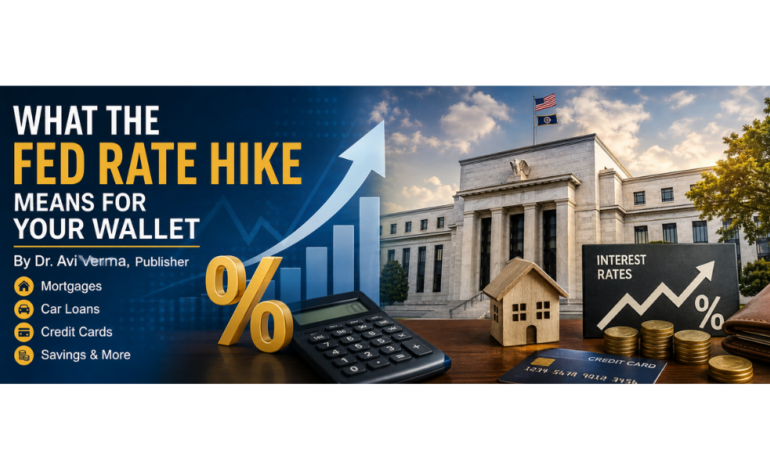
What the Fed rate hike means for your wallet

By: Dr. Avi Verma
The Federal Reserve has raised interest rates again—and for millions of Americans, the immediate question is: What does this mean for my mortgage, car loan, credit card, savings and family budget?
On September 16, the Federal Reserve raised its benchmark federal-funds rate by a quarter percentage point, bringing the target range to 3.75%–4%. It was the first rate increase since 2023. The Fed said inflation remains elevated and that the action is intended to support a timely return to its 2% inflation goal. The decision was unanimous.
What does a Fed rate hike mean?
The federal-funds rate is the interest rate banks charge one another for overnight borrowing. Although consumers do not directly pay this rate, changes in it influence many other borrowing and savings rates throughout the economy.
The basic idea is straightforward: higher interest rates make borrowing more expensive, encourage saving and can slow spending and investment. The objective is to reduce demand sufficiently to ease inflation without causing unnecessary damage to economic growth and employment.
What about mortgages?
If you already have a fixed-rate mortgage, today’s Fed decision does not change your existing interest rate or monthly principal-and-interest payment.
Mortgage rates, however, are influenced more directly by longer-term Treasury yields and expectations for inflation and economic growth. So a quarter-point Fed increase does not automatically mean mortgage rates rise by a quarter point.
For people trying to buy a home, however, higher borrowing costs can reduce purchasing power. Adjustable-rate mortgage borrowers should also review the terms of their loans because their payments can change when the underlying rate resets.
Car loans and other borrowing
Auto loans do not move exactly in step with the Fed’s rate, but higher interest rates generally increase the cost of financing.
For a middle-class family already facing higher housing, insurance, food and transportation expenses, another increase in borrowing costs can make a new vehicle significantly harder to afford.
The same principle applies to personal loans and other variable-rate debt.
Credit cards: the immediate pressure point
Credit-card borrowers are among those most directly exposed to higher short-term rates.
People who pay their balances in full every month may see little practical impact. But families carrying revolving balances can face higher interest charges, making it harder to pay down debt.
That is particularly important because credit-card interest rates are already exceptionally high. A small increase may seem insignificant month to month, but over years of carrying a balance, the additional interest can become substantial.
For consumers, paying down high-interest credit-card debt may therefore become even more important.
What about CDs, money-market accounts and savings?
There is another side to higher rates: savers can benefit.
Higher short-term rates can support better returns on CDs, money-market accounts and high-yield savings accounts. Banks, however, do not necessarily pass the entire Fed increase to depositors immediately.
For Americans with substantial savings, this is a good time to compare what different banks are paying rather than leaving money indefinitely in an account offering little interest.
So the Fed’s decision creates a divide: borrowers generally pay more, while savers may earn more.
Is this economics—or politics?
This is perhaps the most debated question.
The Federal Reserve says its decision is based on economic conditions, particularly its responsibility to maintain price stability and support maximum employment. The Fed’s September statement said economic activity is expanding at a solid pace while inflation remains elevated.
At the same time, the decision comes amid political pressure for lower interest rates and just weeks before the 2026 midterm elections. President Donald Trump has publicly pushed for lower rates, while the Fed has maintained that monetary policy must respond to economic conditions. Reuters reported that the new Fed leadership is signaling that persistent inflation remains a central concern.
It is important to distinguish political consequences from political motivation. The rate hike will have political consequences because interest rates affect household finances, but that does not establish that the decision itself was politically motivated.
What does it mean for the middle class?
For working and middle-class Americans, the bigger issue is the cumulative cost of living.
Families are dealing with housing, food, insurance, transportation and other expenses. Higher interest rates add another burden for those carrying debt or trying to purchase a home or vehicle.
But the impact is not uniform. A family with significant savings may benefit from higher deposit rates, while a family carrying substantial credit-card debt may feel additional financial pressure.
And what about the midterms?
The Fed does not set monetary policy to help or hurt a political party. But its decisions inevitably become part of the economic environment in which voters make their choices.
If inflation remains elevated, voters may continue to focus on the cost of living. If higher rates eventually bring inflation down but weaken housing, investment or employment, those effects could also become part of the public debate.
Ultimately, Americans will judge the economy through their own household experience: Can I afford my mortgage? Can I buy a car? Is my paycheck keeping pace with prices? Is my savings earning a reasonable return?
The Fed controls the benchmark rate, but the consequences are felt around America’s kitchen tables.
For consumers, the message is practical: understand your loan terms, watch high-interest debt, compare savings rates and think carefully before taking on new borrowing.
The quarter-point increase may appear small on paper. For millions of families, however, its effects can accumulate over time.