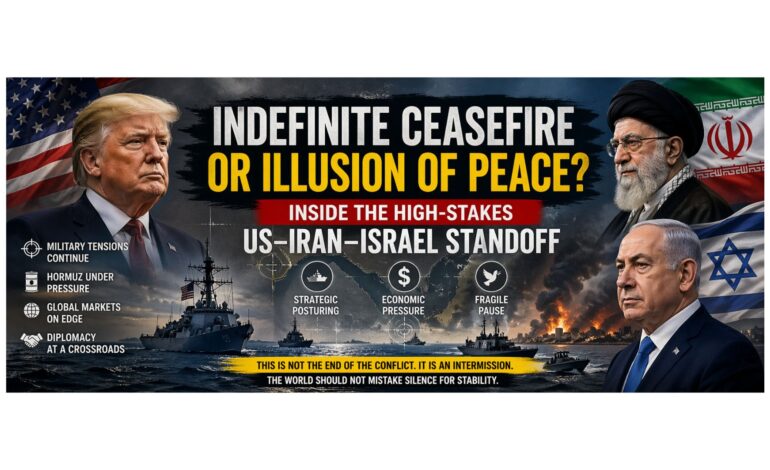
Indefinite ceasefire or illusion of peace?Inside the high-stakes US–Iran–Israel standoff

By: Dr Avi Verma
The rapidly shifting dynamics of the Iran–Israel–United States confrontation have once again exposed how fragile “ceasefires” can be when they are driven more by pressure than by resolution. As of today, the situation is best described not as peace, but as a tense pause layered overactive confrontation—military, economic, and psychological.
Where are we today?
Despite announcements of a ceasefire framework earlier in the week, the ground reality suggests a volatile stalemate. The Strait of Hormuz remains heavily militarized, with U.S. naval enforcement actions, Iranian counter-maneuvers, and commercial shipping disruptions continuing to define the region. Reports of vessel seizures, aggressive maritime warnings, and continued proxy tensions in Lebanon and surrounding theaters indicate that the conflict has not de-escalated—it has merely shifted form.
The strategic objective on all sides appears unchanged. The U.S. continues to apply pressure on Iran’s economic and military capabilities, Israel maintains its security posture against Iranian influence, and Iran is signaling resilience through asymmetric responses.
What does an “indefinite ceasefire” really mean?
An “indefinite ceasefire” without a formal agreement, verification mechanism, or mutual concessions is, in practical terms, a political statement rather than a binding reality. It lacks the architecture of a traditional ceasefire—no monitoring, no guarantees, and no clearly defined obligations.
In this context, the term serves more as a diplomatic placeholder than a genuine de-escalation. It allows all sides to pause without conceding ground, regroup without appearing weak, and recalibrate strategy without formally ending hostilities.
The Trump factor: Strategy or domestic compulsion?
Donald Trump’s unilateral move to declare an indefinite extension—after signaling no continuation of the Pakistan-facilitated ceasefire—raises important questions about intent and timing.
- Domestically, the pressures are undeniable:
- Rising fuel prices have directly impacted American households
- Inflationary concerns tied to energy markets are intensifying
- Stock market volatility is shaking investor confidence
- Sections of the MAGA base are increasingly vocal about economic strain
- The looming midterm elections add political urgency
In this light, the indefinite ceasefire announcement can be interpreted as an attempt to stabilize global energy markets and signal control over a situation that risks spiraling economically. It projects de-escalation without requiring immediate concessions from Iran.
However, this move also reflects a strategic recalibration. Sustained conflict in the Strait of Hormuz threatens not just adversaries but global supply chains—including those critical to U.S. allies.
Contradictions on the ground
Even as the ceasefire narrative is advanced, developments on the ground tell a different story:
The cancellation of a planned diplomatic engagement led by JD Vance to Islamabad signals stalled or strained backchannel negotiations.
U.S. naval actions, including the interception and capture of Iranian vessels, continue
public threats to engage Iranian boats near the Strait of Hormuz escalate tensions rather than ease them.
Iran’s reported seizure of multiple ships demonstrates its willingness to respond asymmetrically.
Taken together, these actions undermine the credibility of the ceasefire claim. They point instead to an active conflict operating below the threshold of declared war—what many analysts describe as “managed escalation.”
Is this a ceasefire or strategic posturing?
The answer lies in the contradictions. A true ceasefire reduces friction points; this situation multiplies them. Military signaling continues. Economic pressure intensifies. Diplomatic channels remain uncertain.
What we are witnessing is not peace, it is positioning.
What lies ahead
The current phase is perhaps more dangerous than open conflict. Miscalculation in such an environment—where forces are active but rules are undefined—can trigger rapid escalation. The Strait of Hormuz remains the most critical flashpoint, with global consequences tied directly to its stability.
For now, the “indefinite ceasefire” offers breathing room, but not resolution. It reflects a convergence of geopolitical strategy and domestic political necessity rather than a durable pathway to peace.
Final word
This is not the end of the conflict, it is an intermission shaped by pressure, perception, and political calculus. Whether it evolves into meaningful diplomacy or slides back into open confrontation will depend on what happens next—not what has been announced.
The world should not mistake silence for stability.