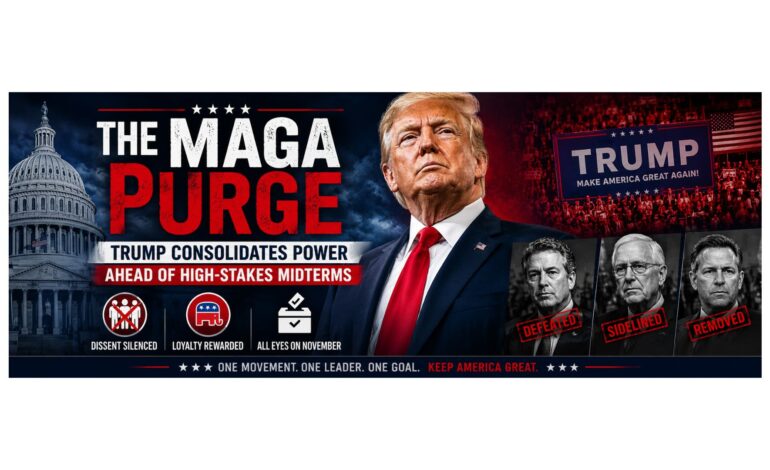
The MAGA purge: Trump consolidates power ahead of high-stakes Midterms

By: Dr Avi Verma
The results of Tuesday’s primaries may well be remembered as the moment the Republican Party completed its transformation from a coalition party into a movement party centered almost entirely around one man — President Donald Trump. What unfolded across Kentucky, Texas, and other states was not simply a routine ideological correction within a political party. It was a systematic purge of dissent.
The defeat of Kentucky Congressman Thomas Massie at the hands of Trump-backed challenger Ed Gallrein sent shockwaves through conservative circles. Massie was hardly a liberal Republican. In fact, he voted with Republicans the overwhelming majority of the time. Yet independence itself became disqualifying. His disagreements with Trump on issues ranging from foreign policy to fiscal spending, and particularly his pressure campaign surrounding the Epstein files, made him a target for political elimination. Trump openly campaigned against him, and the effort succeeded in what became one of the most expensive House primaries in modern history.
At the same time, in Texas, veteran Senator John Cornyn found himself politically isolated after Trump endorsed Attorney General Ken Paxton in the Republican Senate runoff. Cornyn, a longtime establishment conservative and former Senate leadership figure, suddenly represented an older Republican order that no longer commands grassroots enthusiasm within today’s GOP.
This pattern is now unmistakable. Republicans who voted for impeachment after January 6, questioned Trump’s leadership, resisted parts of the MAGA agenda, or even displayed an independent streak are steadily being removed from positions of influence. Figures such as Liz Cheney and Adam Kinzinger were early casualties. Now the purge has expanded deeper into the conservative establishment itself.
The political significance of these primaries extends far beyond the individual races. The Republican Party under Trump is no longer functioning as a traditional “big tent” coalition balancing libertarians, national security conservatives, evangelicals, moderates, and fiscal hawks. Instead, ideological unity and personal loyalty have become the defining tests of political survival.
For Trump politically, this is a remarkable demonstration of strength. Few modern American presidents — current or former — have exercised such direct influence over primary voters years after first taking office. Tuesday proved again that a Trump endorsement can still make or break Republican careers.
But the same strength that dominates primaries may become a liability in a national election.
Primary electorates reward ideological intensity. General electorates reward coalition-building. Those are two very different political environments.
Current polling trends suggest that while Trump-aligned candidates remain popular with Republican base voters, the national environment remains challenging for the GOP overall. Democrats continue to hold an advantage in generic congressional ballot polling, while economic anxieties over inflation, energy costs, and global instability continue to weigh heavily on independent voters.
Even within Republican circles, there are growing concerns that some MAGA-backed candidates may prove too polarizing in competitive suburban districts and swing states. Ken Paxton’s legal controversies, for example, may energize Republican loyalists while simultaneously mobilizing independents and moderates against him in a statewide general election.
This creates the central question heading into November:
Can a party built around ideological loyalty rather than ideological diversity still command a national majority?
If Republicans lose the House this fall, many analysts will interpret it as a rejection of the MAGA consolidation strategy. If they narrowly retain the Senate, it may owe more to the Senate map and structural advantages than to broad national approval of Trump-style politics.
At the same time, Democrats should not assume victory is automatic. Trump’s ability to energize nontraditional voters, dominate media narratives, and maintain intense grassroots enthusiasm remains politically formidable. The Republican base today is arguably more emotionally committed and energized than at any point in recent decades.
Yet Tuesday’s primaries also revealed something deeper about the American political moment: both parties are increasingly punishing internal dissent. The ideological middle ground in American politics continues to shrink, replaced by movements driven more by identity, loyalty, and confrontation than consensus-building.
The Republican Party has now firmly chosen its direction. November will determine whether the broader American electorate accepts that choice — or pushes back against it.