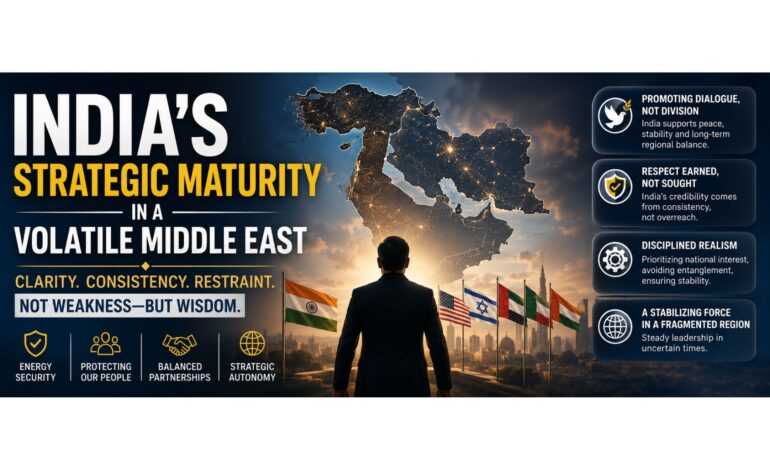
India’s strategic maturity in a volatile Middle East

By: Dr Avi Verma
The Middle East today is suspended in a delicate and deeply uncertain moment. What appears on paper as a ceasefire is, in practice, a fragile pause overshadowed by proxy clashes, cyber operations, and military signaling that reveal how close the region remains to renewed escalation. Intelligence communities across Washington, Brussels, and the Gulf increasingly warn that the current calm is less a step toward peace and more an operational intermission before the next phase of confrontation. In such an environment, the world is searching for stabilizing voices—actors capable of injecting restraint, credibility, and strategic clarity into a landscape defined by volatility.
It is in this context that speculation has grown around the potential role of South Asian powers, particularly India and Pakistan. Yet much of this discussion has been shaped by political imagination rather than geopolitical reality. Mediation in the modern Middle East requires not only diplomatic access but also trust, consistency, and strategic coherence. These qualities are not evenly distributed.
Pakistan has attempted to position itself as a bridge between Washington, Tehran, and the Arab world. But trust—the essential currency of mediation—is precisely where Islamabad faces its greatest challenge. This sentiment was captured bluntly by U.S. Senator Lindsey Graham, who remarked, “I don’t trust Pakistan as far as I can throw them.” His statement reflects a broader skepticism within Western strategic circles, rooted in concerns about Pakistan’s overlapping security commitments and its difficulty maintaining a stable, transparent posture in regional crises.
Allegations that Pakistani airfields quietly accommodated Iranian aircraft during periods of heightened U.S.–Israeli pressure have only deepened doubts. At the same time, Pakistan’s longstanding military deployments in Saudi Arabia and its deep security ties with Gulf monarchies complicate its claims of neutrality. These overlapping alignments do not make Pakistan a villain; they simply illustrate the structural constraints that limit its ability to act as a credible mediator in a conflict where neutrality must be unimpeachable.
India, by contrast, has approached the crisis with a steadiness that stands out in an era of reactive diplomacy. New Delhi has articulated its priorities clearly: safeguarding energy security, protecting millions of Indian nationals living across the Gulf, maintaining balanced relationships with key regional actors, and avoiding unnecessary entanglement in conflicts where its leverage is limited. This is not disengagement—it is disciplined realism.
India’s partnerships with the United States, Israel, and major Gulf states are transparent, long-term, and rooted in national interest rather than tactical improvisation. Its outreach to Israel, expanding defense and technology cooperation with Western partners, and deepening economic ties with Arab nations reflect a coherent strategic vision. Critics may describe this as a departure from traditional non-alignment, but in reality, India has evolved from passive neutrality into responsible strategic autonomy—a doctrine that prioritizes stability over symbolism.
External Affairs Minister Dr. S. Jaishankar captured this approach succinctly when he stated that India “cannot be a broker nation.” This is not an admission of weakness; it is an acknowledgment of the risks inherent in Middle Eastern mediation. Entering the conflict as a formal intermediary could expose Indian expatriates to insecurity, disrupt vital energy flows, and entangle India in a prolonged geopolitical confrontation with limited upside. By declining to chase the spotlight, India is demonstrating a maturity that many larger powers struggle to emulate.
At the same time, India has maintained communication and goodwill across multiple regional actors. Decades of cultural engagement, economic cooperation, and non-interventionist diplomacy have earned New Delhi something rare in global politics: respect without overreach. India does not need to insert itself dramatically into the crisis to be influential; its credibility stems from consistency, restraint, and the perception that it acts from principle rather than opportunism.
Meanwhile, the Middle East itself has become a far more complex diplomatic arena. Strategic alignments, economic dependencies, and military partnerships shape every decision. In this environment, countries like Qatar and Turkey—each with unique leverage and institutional access—may serve as more direct operational channels for negotiation. But this does not diminish India’s importance. Rather, it highlights the value of India’s role as a stabilizing force: a nation that supports dialogue, avoids inflammatory rhetoric, and prioritizes long-term regional balance.
As the region stands at another dangerous crossroads, India’s posture offers a reminder that responsible leadership is not always loud. Sometimes it is defined by clarity, consistency, and the wisdom to avoid actions that generate headlines but undermine stability. In a moment when many actors are driven by impulse or ideological rigidity, India’s strategic maturity stands out as a source of steadiness in an increasingly fragmented Middle East.
“India’s restraint may ultimately prove to be not weakness—but wisdom.”