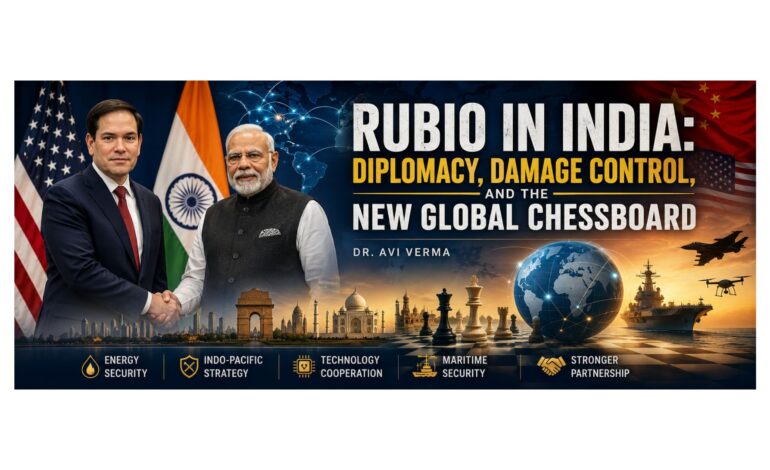
Rubio in India: Diplomacy, damage control, and the new global chessboard

By: Dr. Avi Verma
The visit of U.S. Secretary of State Marco Rubio to India this week was far more than a ceremonial diplomatic engagement. It was a strategic mission wrapped in symbolism, urgency, and geopolitical calculation. At a time when the world is facing mounting instability—from the escalating Iran-Israel-U.S. conflict to rising energy insecurity, China’s growing assertiveness, and shifting alliances in South Asia—Rubio’s India visit signals Washington’s recognition that India remains indispensable to the emerging global order.
For months, Indo-U.S. relations appeared strained. Trade disputes, tariff disagreements, America’s renewed outreach toward Pakistan, and Washington’s inconsistent messaging toward China had generated skepticism in New Delhi. Many in India questioned whether the United States still viewed India as a trusted long-term strategic partner or merely as another transactional ally under an “America First” framework. Rubio’s visit was clearly designed to repair that trust deficit.
Yet the larger question remains: Why now?
The answer lies in the rapidly evolving global crisis.
The ongoing confrontation involving Iran, Israel, and the United States has shaken international energy markets and threatened global oil supply routes, particularly around the Strait of Hormuz. India, one of the world’s largest energy importers, sits at the center of this storm. Washington understands that India’s energy security is now directly tied to global economic stability. Rubio openly pushed for deeper U.S.-India energy cooperation, emphasizing America’s willingness to become a major long-term energy supplier to India.
This was not merely about oil and gas.
It was about preventing India from drifting further toward strategic neutrality—or worse, toward alternative power blocs led by China and Russia. Rubio’s repeated references to India as a “natural partner” and a cornerstone of Indo-Pacific strategy underline America’s realization that it cannot effectively counter China without India firmly within its strategic orbit.
The Quad alliance also loomed large over the visit. With concerns growing that the Quad had lost momentum, Rubio’s India trip attempted to reassure allies that Washington remains committed to the Indo-Pacific architecture. Discussions on semiconductors, artificial intelligence, critical minerals, defense technology, and maritime security reveal that the U.S.-India relationship is evolving far beyond traditional diplomacy.
At the same time, the visit carries major implications for Pakistan.
Islamabad has recently tried to reposition itself as a diplomatic intermediary amid Middle East tensions, while simultaneously strengthening ties with Washington. Rubio’s engagement with Pakistani leadership shortly before and after the India visit reflects a careful balancing act by the United States.
However, this balanced strategy comes with risks.
India remains deeply cautious about any U.S. attempt to “hyphenate” India and Pakistan diplomatically. For decades, New Delhi has worked hard to establish itself as a global power distinct from the South Asian regional framework historically dominated by India-Pakistan rivalry. Any perception that Washington is reviving old balancing formulas could create fresh distrust.
Did India give Rubio a cold shoulder?
Not publicly. Prime Minister Narendra Modi and External Affairs Minister Subrahmanyam Jaishankar maintained diplomatic warmth and emphasized continued cooperation. Rubio was welcomed with ceremonial engagements, strategic meetings, and cultural outreach across multiple Indian cities.
But beneath the optics, India’s response appeared measured rather than enthusiastic.
There was no dramatic breakthrough announcement. No sweeping trade agreement. No major defense package. No extraordinary strategic declaration. Instead, India projected confidence, caution, and strategic autonomy. New Delhi appears increasingly aware that global powers now need India as much as India needs them.
That may be the biggest geopolitical shift of all.
Unlike previous decades, India today negotiates from a position of growing economic strength, technological importance, military relevance, and demographic power. Washington’s urgency in rebuilding trust with New Delhi reflects that changing reality. India is no longer merely a regional partner—it is now central to global supply chains, Indo-Pacific security, critical technology competition, and energy stability.
The Rubio visit therefore represents something deeper than routine diplomacy.
It reflects America’s recognition that the future global balance of power may depend significantly on the direction India chooses in the coming decade.
For India, the challenge will be maintaining strategic independence while maximizing opportunities from multiple global partnerships. For the United States, the challenge will be proving that its commitment to India extends beyond temporary geopolitical necessity.
Because in today’s fractured world order, trust—not symbolism—will define the future of Indo-U.S. relations.