U.S.-Canada Tariff War: Another Trade Battle—and a Warning for India

By: Dr. Avi Verma
Just when the global economy appeared to be adjusting to a new era of American tariffs, another major trade confrontation has erupted—this time between the United States and Canada, two of the world’s closest allies and most deeply integrated trading partners.
For the Indian-American community, this development deserves particular attention. India is already navigating a complicated trade relationship with Washington. The question is no longer simply what happens between America and Canada. It is whether a growing network of tariff disputes could reshape global trade—and where India should position itself in that changing landscape.
What Triggered the New Conflict?
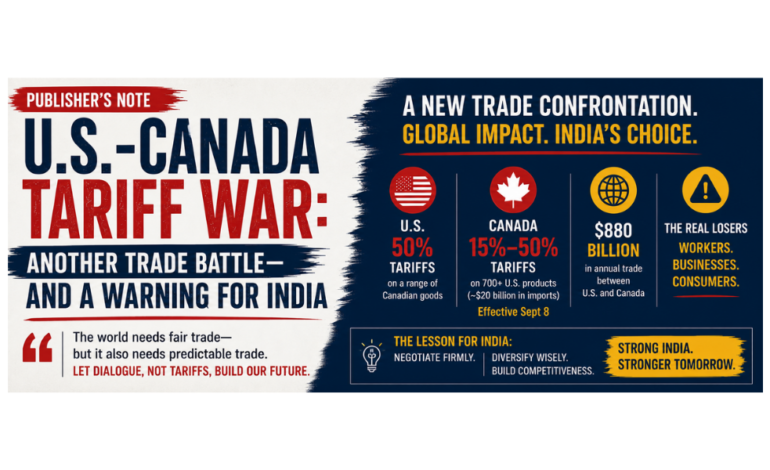
The latest escalation followed the collapse of U.S.-Canada trade negotiations. Washington has imposed 50% tariffs on a range of Canadian goods, while Canada has announced retaliatory tariffs ranging from 15% to 50% on more than 700 U.S. products, covering approximately $20 billion in imports. Canadian measures are scheduled to take effect September 8.
The dispute involves longstanding disagreements over market access, including Canadian treatment of American products in sectors such as dairy and automobiles, as well as steel and aluminum and broader questions about trade barriers.
President Donald Trump views tariffs as leverage. His argument is that the United States has tolerated unfair trade arrangements for too long and that tariffs can protect American workers and industries while forcing trading partners to offer greater access to their markets.
From Washington’s perspective, tariffs are therefore not necessarily the destination—they are a negotiating weapon.
Canada Says Enough Is Enough
Canadian Prime Minister Mark Carney has taken a fundamentally different view. Ottawa argues that Canada has already made significant concessions and that Washington’s demands and tariff measures threaten Canada’s economic sovereignty.
Canada has chosen retaliation rather than capitulation, while simultaneously introducing support measures for affected businesses and workers. The dispute has consequently become more than a technical disagreement over tariffs. For many Canadians, it has become a question of national sovereignty and economic independence.
Carney has also suggested that the era of ever-deeper dependence on the U.S. market may be changing.
That should concern Washington as much as Ottawa.
Who Wins—and Who Loses?
The uncomfortable reality is that a prolonged trade war has very few genuine winners.
Some American industries may benefit from protection against Canadian competition. The U.S. government also collects tariff revenue. Canadian producers competing against American imports could similarly gain temporary protection.
But the broader economic consequences are more complicated.
American manufacturers that depend on Canadian steel, aluminum, energy, lumber and other inputs could face higher costs. Canadian companies face the loss of access to their largest export market. Consumers on both sides of the border could ultimately pay more.
The two countries have approximately $880 billion in annual trade, with highly integrated supply chains, particularly in automobiles, manufacturing, agriculture and energy.
An automobile component can cross the border several times before a vehicle reaches a showroom. A tariff imposed at one stage can therefore increase costs throughout the production chain.
The real losers could be workers, businesses and consumers.
And Where Does India Stand?
This is where the story becomes particularly important for our IndoUS Tribune readership.
India is already dealing with its own complicated tariff negotiations with the United States. Washington and New Delhi have been working toward a trade framework, while disagreements over tariffs and market access remain important issues.
The U.S.-Canada confrontation offers India both a warning and an opportunity.
The warning is obvious: today’s international trade environment is increasingly unpredictable. Agreements that once appeared stable can quickly become bargaining chips.
The opportunity is equally significant.
Canada is already looking to diversify its trading relationships, and Indian markets are attracting greater Canadian attention. India, meanwhile, has an opportunity to strengthen its position as an alternative manufacturing and supply-chain destination.
For New Delhi, the lesson should be clear: trade policy must increasingly be viewed as an extension of economic and strategic policy.
India should negotiate firmly with Washington, but simultaneously deepen trade relationships with Europe, Canada, the Gulf, Southeast Asia and other major markets.
Could This Create Another Global Economic Shock?
One U.S.-Canada tariff confrontation is unlikely by itself to throw the world economy into turmoil.
The greater danger is cumulative escalation.
The United States is simultaneously managing tariff disputes and negotiations with multiple trading partners. When one country imposes tariffs and another retaliates, supply chains become less predictable, investment decisions are delayed and businesses pass higher costs to consumers.
Economists are already warning that the U.S.-Canada escalation could increase inflationary pressure and disrupt North American manufacturing.
If similar disputes multiply across the global economy, the consequences could include:
higher consumer prices, disrupted supply chains, weaker investment and slower economic growth.
The greatest danger is therefore not one tariff.
It is the normalization of retaliation.
Trump Is Betting on Leverage. Canada Is Betting on Resistance.
There is a legitimate argument behind Trump’s position. The United States has genuine concerns about market access and protecting domestic industries. No major economy should be expected to accept permanently unequal trade arrangements.
Canada’s concerns are equally legitimate. A country whose economy is deeply integrated with its largest neighbor cannot easily absorb sudden tariff shocks without consequences for workers and businesses.
Both sides therefore have a point.
But neither side can escape economic reality.
The United States needs Canadian energy, materials, components and markets. Canada needs access to the enormous American consumer market.
Their economic interdependence is not a weakness—it can be the foundation for a better agreement.
The Larger Lesson for India and the World
India should watch this confrontation carefully.
For decades, globalization was built around the assumption that trade would increasingly transcend politics. Today, the opposite appears to be happening: geopolitics is increasingly shaping trade.
India must therefore diversify its markets, strengthen domestic manufacturing, improve competitiveness and use its enormous consumer market as negotiating strength.
At the same time, India should resist being drawn into a world where every disagreement becomes a tariff confrontation.
Trade Wars Have No Real Victory Parade
The United States wants better trade terms. Canada wants economic sovereignty. India wants fair access to global markets.
All three objectives are legitimate.
But the answer cannot permanently be:
Tariff → retaliation → counter-retaliation → higher prices → economic uncertainty.
The United States and Canada are neighbors, allies and economic partners. They have too much at stake to allow political rhetoric to permanently damage an economic relationship worth hundreds of billions of dollars.
For India, the message is equally important.
India should welcome opportunities created by global supply-chain diversification—but not celebrate the economic troubles of others.
A fragmented global economy ultimately hurts everyone.
The world needs fair trade—but it also needs predictable trade.
And as America, Canada and India negotiate their respective economic futures, perhaps the most important question is not:
“Who wins the tariff war?”
It is:
“Can the world’s major economies learn to compete without turning every disagreement into an economic war?”
For the United States, Canada, India and the global economy, the negotiating table remains far cheaper than the battlefield of tariffs.