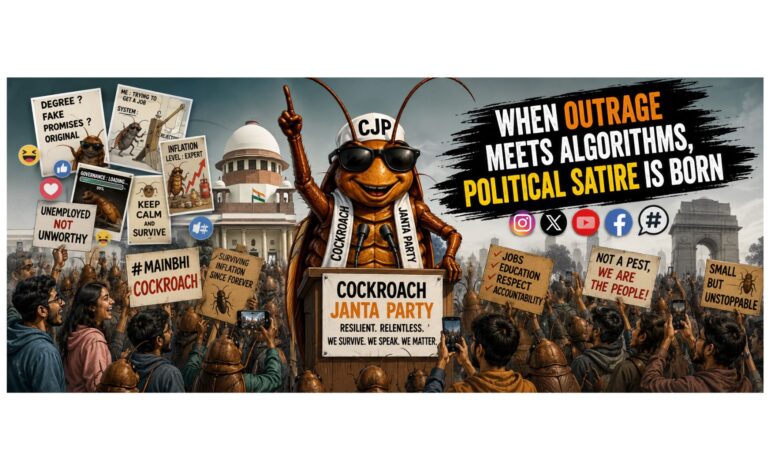
When outrage meets algorithms, political satire is born

By: Dr Avi Verma
There was a time when political satire lived in newspaper cartoons, late-night comedy shows, or whispered jokes at tea stalls. In today’s India, satire is born on Instagram reels, spreads through hashtags, weaponizes memes, and reaches millions before television debates can even react.
The sudden rise of the “Cockroach Janta Party” (CJP) is not merely an internet joke. It is a reflection of a changing political culture where outrage, unemployment, frustration, and social media have combined to create a new form of digital rebellion.
The controversy began after remarks attributed to Chief Justice of India Surya Kant during a Supreme Court proceeding in May 2026. The comments, widely interpreted online as comparing unemployed youth and institutional critics to “cockroaches” and “parasites,” triggered instant backlash across India’s hyperactive digital ecosystem. Though the Chief Justice later clarified that his remarks were directed at individuals using fake degrees and not at India’s unemployed youth as a whole, the internet had already delivered its verdict.
Within days, communications strategist Abhijeet Dipke transformed the insult into a movement by launching the “Cockroach Janta Party” — a satirical political platform that mocked both the establishment and the frustrations of modern India. What followed was extraordinary. Millions of young Indians rallied behind the hashtag #MainBhiCockroach, sharing memes, AI-generated insect mascots, parody campaign videos, and dark humor aimed at unemployment, inflation, corruption, and institutional arrogance.
For many older Indians, this may appear unserious. But history teaches us that political satire often begins as comedy before evolving into a deeper social expression.
From Charlie Chaplin mocking fascism to television comedians influencing elections in the West, satire has always flourished when citizens lose faith in formal political communication. In India too, cartoons during the Emergency era, political mimicry, and stand-up comedy have long served as pressure valves against authority. The difference now is speed. Social media compresses outrage, humor, mobilization, and amplification into a matter of hours.
The CJP is the first major Gen Z political satire movement in India to achieve national scale almost entirely through algorithms rather than organization.
That alone makes it politically significant.
The movement’s rapid growth exposed a deeper reality: beneath India’s economic optimism lies an undercurrent of anxiety among millions of educated young people struggling with unemployment, rising living costs, competitive exam controversies, and diminishing trust in institutions. The cockroach became symbolic — not because youth admired the insect, but because they identified with its resilience and survival instincts in hostile conditions.
The ruling establishment initially dismissed the movement as a meaningless digital fad. BJP leaders argued, correctly, that political power is not built through Instagram followers alone. India’s elections are still won through booth-level organization, caste equations, welfare delivery, and ground mobilization developed over decades.
Yet the state’s response soon revealed something else — nervousness.
Reports of social media restrictions, blocked accounts, allegations of foreign influence, and threats directed at the movement’s founder elevated the issue far beyond parody. Once governments begin treating memes as matters of national security, satire acquires unintended legitimacy.
And that is where the Cockroach Janta Party becomes more than a joke.
Is the CJP a genuine political movement? Not yet.
It has no Election Commission registration, no visible grassroots structure, no ideological coherence, and no roadmap for electoral conversion. At present, it remains primarily a digital protest phenomenon driven by outrage and internet culture.
But dismissing it entirely would also be shortsighted.
Modern politics is increasingly shaped by perception before policy. Social media does not need to win elections immediately to influence narratives, embarrass governments, shape public discourse, or energize dissatisfied demographics. The CJP has already succeeded in forcing India’s political class to confront an uncomfortable truth: the country’s digital generation is losing patience with traditional political messaging.
The larger question is whether this frustration remains confined to satire or evolves into organized political energy.
Historically, youth-led digital uprisings have followed two paths. Most collapse under the weight of their own virality, fading as quickly as they emerge. Others become incubators for future political leaders, movements, or ideological shifts. India itself witnessed how anti-corruption protests in the early 2010s eventually transformed into mainstream political movements.
Could the CJP follow that trajectory? Possibly — but only if it evolves beyond memes into sustained issue-based engagement.
At the same time, the movement also exposes the limitations of India’s opposition parties. The fact that millions of young Indians gravitated toward satire instead of established opposition platforms suggests a widening vacuum in political representation. Many youth appear more comfortable expressing dissent through irony than through conventional party politics.
For the BJP, the CJP is not yet an electoral threat. The ruling party remains the most organized political force in India with unmatched grassroots infrastructure and a powerful leadership-driven narrative.
But the movement is a warning signal.
It reflects a growing emotional disconnect between sections of urban youth and the political establishment. And in politics, emotional disconnect often appears online long before it becomes visible at the ballot box.
Ultimately, the Cockroach Janta Party may disappear within weeks or months. Viral movements often do. But its legacy may endure as a case study in the future of political communication.
It demonstrated that in the age of algorithms, satire can mobilize faster than speeches, memes can outperform manifestos, and ridicule can become a form of resistance.
Most importantly, it proved that when outrage and social media come together, political satire is no longer entertainment alone.
It becomes a language of dissent.