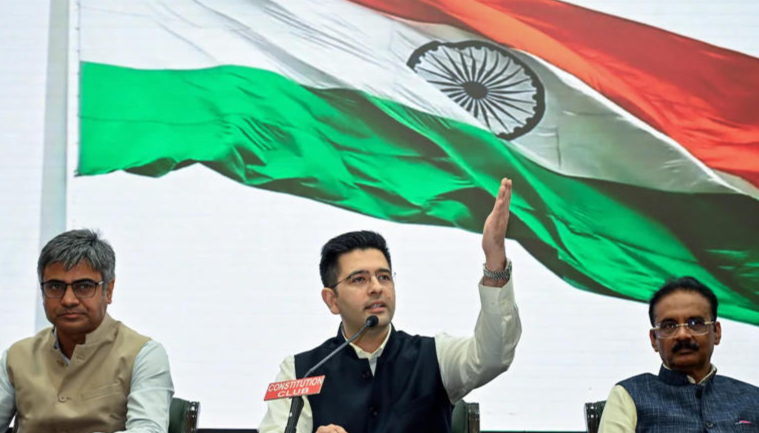
AAP’s Rajya Sabha exodus: A constitutional loophole or political reckoning?

By: Dr. Avi Verma
The sudden resignation of seven out of ten Aam Aadmi Party (AAP) members in the Rajya Sabha is not just another episode of political realignment—it is a moment that tests both the spirit of India’s anti-defection law and the structural resilience of a party that rose on the promise of clean politics.
At the heart of this development lies a deceptively simple question: Can numbers override constitutional intent?
The answer, as it stands today, is complicated.
India’s anti-defection framework, embedded in the Tenth Schedule of the Constitution, was designed to prevent opportunistic political switching. Yet it contains a critical exception: if two-thirds of a legislative party agree to merge with another party, they can avoid disqualification. On paper, the exit of seven out of ten AAP Rajya Sabha MPs appears to fit neatly within this threshold.
But constitutional morality is rarely that straightforward.
The law does not merely require a numerical split—it requires evidence of a genuine merger of the political party itself, not just a coordinated exit by its legislators. Recent judicial interpretations have increasingly emphasized that this provision cannot be reduced to arithmetic alone. In that sense, what we are witnessing is not a clean legal bypass, but a high-stakes constitutional grey zone—one that may ultimately require adjudication.
Beyond legality, however, lies the deeper political story.
The exodus exposes a structural vulnerability within AAP that has long been discussed but seldom tested at this scale. Unlike traditional parties, AAP’s Rajya Sabha representation has relied heavily on nominated individuals—industrialists, professionals, and public figures—rather than grassroots politicians with independent electoral bases. This model, while effective in bringing expertise into Parliament, carries an inherent risk: loyalty rooted in nomination rather than mass politics can prove fragile under pressure.
The current crisis appears to validate that concern.
Publicly, the departing members have justified their decision by claiming that the party has drifted from its founding ideals. That argument may resonate in parts, but it is difficult to ignore the timing and scale of the move. The more persuasive explanation lies at the intersection of political opportunity, centralized leadership, and limited internal dissent mechanisms. A party built on disruption is now confronting the consequences of its own centralized control.
For Punjab, where AAP holds power, the implications are more nuanced than immediate.
It is important to recognize that Rajya Sabha members are not directly elected by the people. Their exit does not reflect a shift in voter sentiment in Punjab, nor does it alter the arithmetic of the state विधानसभा, where AAP continues to hold a comfortable majority. In purely institutional terms, the government remains stable.
Yet politics is as much about perception as it is about numbers.
Opposition parties are already framing the episode as evidence that AAP imposed “outsiders” on Punjab—leaders with limited connection to the state’s political fabric. This narrative, if it gains traction, could erode AAP’s carefully cultivated image as a party of ethical governance and grassroots accountability. The damage, therefore, is less about immediate power and more about long-term credibility.
The larger question is whether this moment signals the beginning of a broader unraveling.
History suggests caution. Political defections at the parliamentary level do not automatically translate into state-level instability. For Punjab to witness a change in government, the unrest would have to spread to the legislative assembly—a scenario for which there is currently no clear evidence. However, if the exodus reflects deeper dissatisfaction within the party’s ranks, it could gradually weaken organizational cohesion and embolden challengers.
In that sense, Punjab is not on the brink of political collapse—but it is entering a phase of heightened vulnerability.
What makes this episode particularly significant is what it reveals about the anti-defection law itself. Designed in the 1980s to curb the infamous culture of “Aaya Ram, Gaya Ram,” the law sought to bring stability to India’s parliamentary democracy. Yet over time, it has produced an unintended paradox: individual dissent is penalized, while collective defection—if numerically sufficient—is protected.
The result is a system where political actors are incentivized not to act alone, but to defect in groups large enough to meet the legal threshold. In practice, this transforms what should be an exception into a strategic tool.
That is precisely what appears to be unfolding now.
The AAP exodus, therefore, is not merely a story about one party’s internal crisis. It is a reminder that constitutional safeguards are only as strong as their interpretation and enforcement. If the law can be navigated through coordinated exits dressed up as “mergers,” then its original purpose stands diluted.
For AAP, the challenge is immediate and existential: to restore internal trust, recalibrate leadership structures, and reconnect with its foundational promise. For the broader political system, the challenge is more enduring—to revisit whether the current framework of the anti-defection law truly serves the democratic ideals it was meant to protect.
Punjab may not see a change in government today. But the tremors from this episode will be felt well beyond the state—and well beyond this moment.
Because in the end, this is not just about who leaves a party. It is about *what remains of the principles that brought it to power