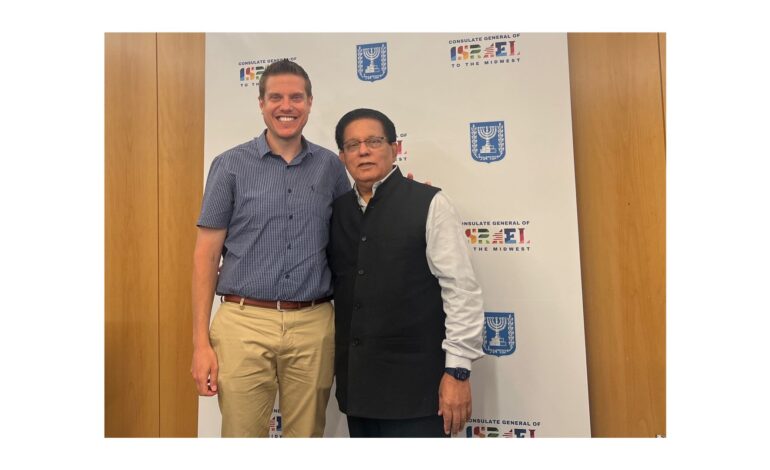
Partners in progress Elad Strohmayer on India, Israel and a changing Middle East

As the Middle East undergoes one of its most consequential strategic realignments in decades, the relationship between India and Israel is entering a new phase shaped by shared security concerns, technological collaboration, and expanding economic opportunities. Against the backdrop of shifting regional dynamics following Israel’s recent military campaign against Iran, questions surrounding diplomacy, regional stability, and emerging partnerships have taken on renewed significance.
In an exclusive conversation with Dr. Avi Verma, Publisher of IndoUS Tribune, Elad Strohmayer, Israel’s Consul General to the Midwest, discusses the impact of the Iran conflict, the changing balance of power in the Middle East, and why he believes the India-Israel partnership is poised for even greater growth. From regional security and the India-Middle East-Europe Economic Corridor (IMEC) to entrepreneurship, innovation, and people-to-people ties, Strohmayer outlines his vision for deeper cooperation among India, Israel, and the United States.
Discussing Israel’s military campaign against Iran, Strohmayer said the operation had achieved one of its principal objectives by forcing Tehran back to the negotiating table while substantially reducing its ability to threaten Israel. “It was very successful because that’s what brought Iran to the negotiating table,” Strohmayer said. “Iran was very weakened. Its launching capabilities toward Israel have been severely damaged. They haven’t been eliminated completely, but they have been significantly reduced.”
He added that the campaign had also set back Iran’s nuclear program and stressed that the international community must ensure Tehran is unable to rebuild those capabilities.
“The job now is to make sure this regime cannot threaten Israel, the Middle East, the United States or the wider world again,” he said.
Strohmayer believes the regional balance of power is beginning to shift, pointing to direct engagement between Israel and Lebanon as evidence of changing dynamics in the Middle East. According to him, countries in the region increasingly recognize that Iranian influence, particularly through Hezbollah, has contributed to prolonged instability.
“A weakened Iran has created opportunities for countries in the region to work together,” he said. “Israel is increasingly viewed as a moderate force standing against extremism.”
Turning to India, Strohmayer described the India-Israel relationship as one built on shared history, democratic values, and a common outlook for the future. “We’re remarkably similar countries,” he said. “We both gained independence around the same period after colonial rule. We respect our history and traditions while looking toward the future through innovation and technology.”
He said both nations have emerged as global centers of entrepreneurship and innovation, creating a strong foundation for expanding cooperation in technology, security, trade, education, and research.
Strohmayer also highlighted the United States as an important partner in strengthening this relationship. “When you bring the United States into the equation, the possibilities become even greater,” he said.
Among the initiatives he believes could reshape regional cooperation is the India-Middle East-Europe Economic Corridor (IMEC), which seeks to improve trade and connectivity between India and Europe through the Middle East.
According to Strohmayer, the proposed corridor would strengthen supply chains, facilitate commerce, and contribute to greater economic stability by connecting India with moderate partners across the region.
He also underscored the significance of the I2U2 grouping, comprising India, Israel, the United States, and the United Arab Emirates, describing it as an example of how strategic partnerships can address shared challenges. “If moderate countries work together, we can fight extremism, promote innovation and create a better future for the next generation,” he said.
Beyond government-to-government engagement, Strohmayer believes lasting partnerships are built through stronger connections between people. He praised the growing interaction between the Indian and Jewish communities in the United States, noting that both communities increasingly participate in one another’s cultural celebrations, including India’s Republic Day, Israel’s Independence Day, and Hanukkah events.
“Our countries already have an excellent relationship,” he said. “There is every reason for our communities in the United States to enjoy the same close friendship.”
While cultural exchanges remain important, he believes the next phase of cooperation should focus on entrepreneurs, innovators, researchers, and business leaders working together to create tangible economic opportunities. “If Israeli and Indian entrepreneurs work together, we won’t just be celebrating our friendship—we’ll be building businesses, developing technologies and improving lives,” he said.
He encouraged entrepreneurs interested in collaborating with Israeli companies to reach out to the Consulate, saying his office remains committed to fostering new commercial partnerships.
Reflecting on the broader India-Israel relationship, Strohmayer said both countries understand the challenges posed by terrorism and remain committed to democratic values, security, innovation, and long-term cooperation.
As the conversation concluded, he emphasized the importance of unity at a time of increasing polarization around the world. “There are many loud extremist voices trying to divide people,” he said. “We should not allow that to happen. There is far more that brings us together than separates us.”
Looking ahead, Strohmayer expressed confidence that closer collaboration among India, Israel, and the United States could drive meaningful advances in technology, economic development, and regional stability.
“If we continue strengthening our partnerships, supporting one another and focusing on our shared values,” he said, “the sky is the limit.”