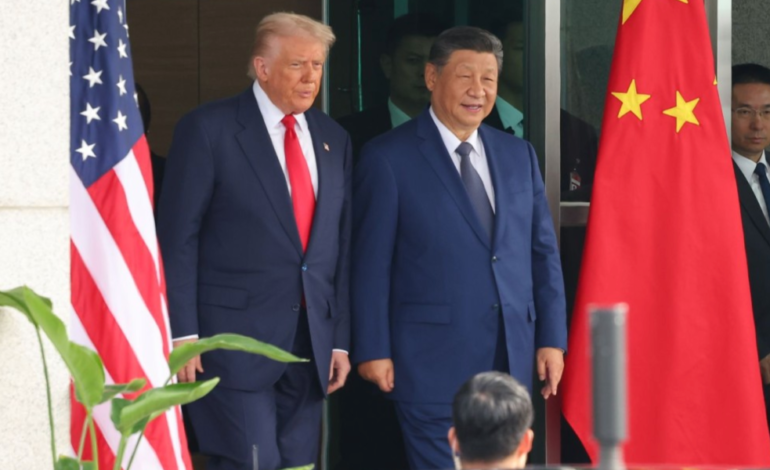
Trump to visit China amid trade push

US President Donald Trump will travel to Beijing this week for a high-profile diplomatic visit aimed at easing tensions and expanding cooperation between the world’s two largest economies, the White House announced on Sunday.
Trump is scheduled to arrive in the Chinese capital on Wednesday evening, where he will hold extensive talks with Chinese President Xi Jinping covering trade, investment, artificial intelligence, Taiwan, Iran, and broader security issues.
According to White House Principal Deputy Press Secretary Anna Kelly, the visit carries major geopolitical significance and is expected to focus heavily on economic negotiations designed to reshape US-China commercial relations.
“This will be a visit of tremendous symbolic significance,” Kelly told reporters. “But President Trump never travels for symbolism alone.”
The White House said Trump and Xi will participate in a welcome ceremony before holding bilateral meetings on Thursday morning. The leaders are also expected to tour Beijing’s historic Temple of Heaven and attend an official state banquet hosted by the Chinese government. Additional working sessions and a bilateral lunch are scheduled for Friday before Trump departs China.
US officials said one of the central goals of the visit is to “rebalance trade with China” while prioritizing American workers, businesses, and farmers. Discussions are expected to include proposals for a new US-China Board of Trade and a US-China Board of Investment designed to improve economic coordination and address long-standing trade disputes.
Senior administration officials indicated that the proposed trade framework could involve agreements worth billions of dollars, particularly in agriculture, aerospace, and energy sectors. However, officials rejected speculation regarding any large-scale Chinese investment package.
“There’s not a proposal out there for some massive investment,” one senior US official clarified.
The talks are also expected to focus heavily on Iran and regional security concerns. US officials said Trump plans to pressure Beijing over its economic ties with Tehran and Moscow, including concerns regarding dual-use technologies and revenue flows linked to sanctioned sectors.
Artificial intelligence is also emerging as a major topic on the bilateral agenda. American officials described AI as a rapidly evolving sector with significant national security implications. Washington is reportedly exploring the possibility of establishing direct communication channels with Beijing on AI governance and security matters.
Taiwan will remain another sensitive subject during the discussions. While US officials reiterated there has been “no change” in Washington’s Taiwan policy, they confirmed that the Trump administration has approved significantly increased arms sales to Taiwan compared to previous years.
The visit comes at a critical moment in US-China relations, which remain strained over trade disputes, technology restrictions, cyber concerns, military competition in the Indo-Pacific, and China’s relations with Russia and Iran.
Despite these tensions, both governments appear eager to prevent further escalation while exploring areas of strategic economic cooperation.