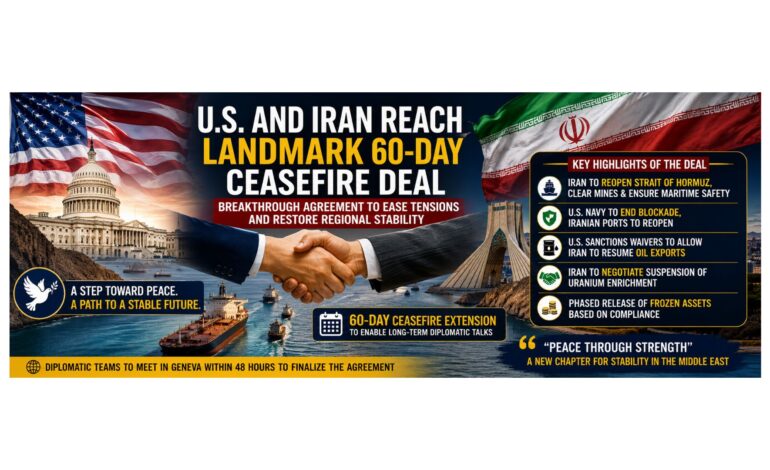
U.S. and Iran reach landmark 60-day ceasefire deal amid major diplomatic breakthrough

President Donald Trump announced that the United States and Iran have largely negotiated a landmark Memorandum of Understanding aimed at reducing tensions in the Middle East and preventing a wider regional conflict.
According to the proposed framework, both nations have agreed to a 60-day extension of the current ceasefire while diplomatic negotiations continue toward a longer-term settlement.
One of the most significant aspects of the agreement involves the Strait of Hormuz, a critical global energy shipping route. Iranian authorities have reportedly agreed to immediately reopen the strategic waterway, begin clearing naval mines, and halt threats against commercial shipping vessels operating in the region.
In return, the United States is expected to ease certain restrictions, including ending naval blockade operations around Iranian ports to allow the resumption of commercial trade and maritime activity.
The agreement also includes several major diplomatic and economic provisions. The Trump administration is expected to issue sanctions waivers that would allow Iran to resume international oil exports, potentially easing pressure on global energy markets. Discussions are also expected to begin regarding the suspension of Iran’s uranium enrichment activities as part of future nuclear negotiations.
Additionally, the phased release of frozen Iranian assets is reportedly tied to Iran’s compliance with the terms of the agreement and international verification mechanisms.
The White House described the development as a major achievement for what President Trump has frequently called a strategy of “peace through strength.” Administration officials said the agreement could mark an important step toward stabilizing the region after months of heightened military tensions and maritime security concerns.
However, Iranian state media appeared more cautious in its reaction, suggesting that negotiations over certain details — particularly the management and security arrangements surrounding the Strait of Hormuz — are still ongoing.
Global financial markets reacted quickly to the news. Oil prices declined amid expectations that increased Iranian crude exports could return to international markets in the coming months, potentially easing supply concerns.
Diplomatic delegations from both countries are expected to meet in Geneva within the next 48 hours to finalize the agreement and continue broader discussions on regional security, trade, and nuclear issues.
If successfully implemented, the agreement could become one of the most significant diplomatic developments in U.S.-Iran relations in recent years and may reshape the geopolitical dynamics of the Middle East.